

The traditional MBA is built for a world that no longer exists. The case method, the cohort structure, the two-year residency — these were engineered for mid-twentieth-century corporations with stable hierarchies, slow information cycles, and a workforce that could afford to stop working for two years and go back to school. That world is gone.
What replaced it is faster, more volatile, and far more dependent on how people actually think under pressure than on what they were taught in a case study thirty years ago. The gap between what the traditional MBA delivers and what leadership actually demands has never been wider.
An online executive MBA built around behavioral science and neuroscience closes that gap. Not as a philosophical upgrade — as a structural one. This article explains why.
What this article covers:
- Why the traditional MBA model was designed for a different economy
- What the neuroscience of learning reveals about how executive education actually works
- The specific gaps the traditional MBA leaves unfilled
- How the Executive Neuro MBA addresses them
- What to look for if you’re comparing programs
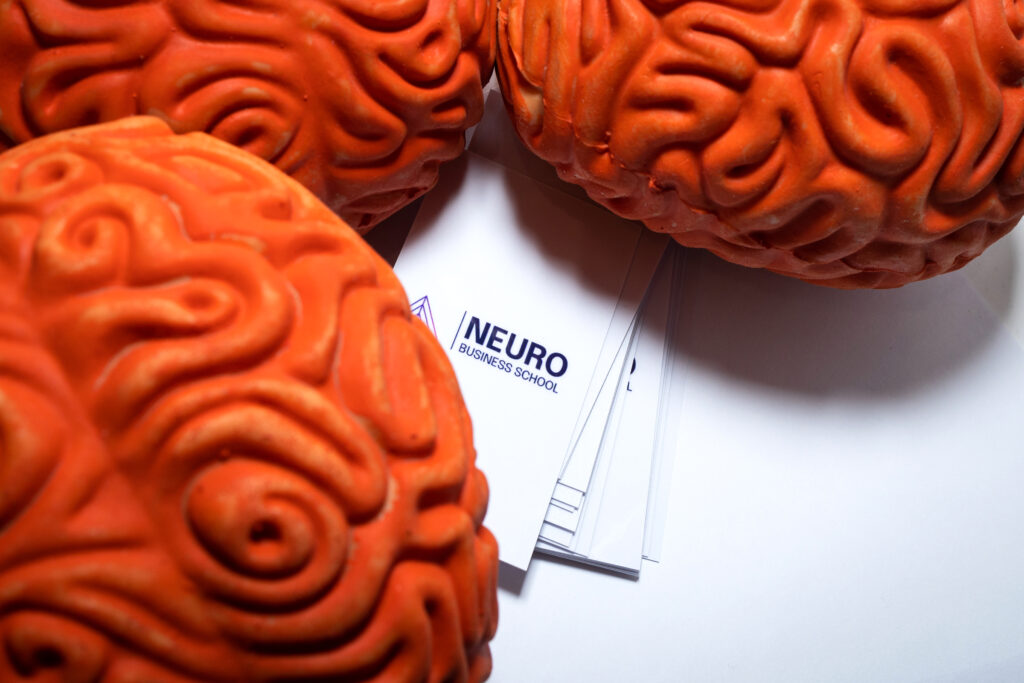
What Was the Traditional MBA Actually Designed to Do?
The MBA was formalized in the United States in the early twentieth century — Harvard Business School launched its program in 1908. The model it created was built around a specific set of assumptions: that management was a learnable set of techniques, that case studies from successful companies could serve as transferable templates, and that two years of full-time study would produce a broadly capable generalist who could step into any organization and create value.
For several decades, those assumptions were largely correct. The postwar economy rewarded scale, process efficiency, and rational resource allocation. The MBA delivered managers who could optimize those things. And the degree itself became a powerful credential in a credential-conscious market.
The problem is that the economy changed. The assumptions did not.
Today’s business environment is characterized by ambiguity, speed, and what organizational psychologists call decision fatigue — the degradation of judgment that occurs when people are required to make too many consequential choices under pressure. The traditional MBA addresses none of this directly. It teaches frameworks. It does not teach the brain that has to apply them.
Image concept: A timeline graphic showing two diverging paths — one labeled “1950s economy” leading to a traditional MBA building, one labeled “2020s economy” leading to a screen-based, distributed workspace. Clean and minimal.

What Does the Neuroscience of Learning Actually Show?
Here is what the research actually shows: the human brain does not learn well in long, passive sessions. It learns through spaced repetition, application under relevant conditions, and emotional engagement with the material.
A 2013 study published in Psychological Science found that spaced practice — learning broken into shorter sessions over time — produced dramatically better long-term retention than massed practice (the traditional “block of content, then move on” approach). A 2021 review in Nature Reviews Neuroscience confirmed that cortisol levels — elevated by high-stakes, evaluative environments like traditional exams — impair the prefrontal cortex, the part of the brain most responsible for strategic thinking.
The traditional MBA does the opposite of what the neuroscience recommends. It concentrates content into intensive blocks, evaluates through high-stakes examinations, and separates learning from the professional contexts in which that learning needs to be applied.
The neuroscience of learning argues for exactly the model that well-designed online executive programs now make possible: shorter sessions, distributed over time, applied to real problems the learner is facing in their current role. Not as a convenience feature. As a pedagogical advantage.
The MBA teaches frameworks. It does not teach the brain that has to apply them.
Where Does the Traditional MBA Fall Short Specifically?
Three gaps matter most for professionals in leadership roles.
The decision science gap
Most MBA curricula treat decision-making as a rational process that can be optimized through better frameworks and more data. The last thirty years of behavioral economics — and the last fifteen years of cognitive neuroscience — have established conclusively that this is wrong. Human decisions are driven by heuristics, emotional states, cognitive load, and context in ways that no framework corrects for.
A program that does not teach the actual mechanisms of human judgment is leaving its students with an incomplete map. They will apply frameworks to a territory the frameworks do not fully describe.
The neuroplasticity gap
The traditional MBA does not typically teach executives how to change. It teaches what to think, not how to update the way you think under new conditions. Neuroplasticity research has demonstrated that adult brains remain far more malleable than was previously understood — but that malleability is not activated by passive instruction. It requires deliberate practice, error and correction, and application in conditions that replicate the real environment.
An executive who understands how their own cognitive patterns form and change is better positioned to lead through uncertainty than one who has memorized the competitive forces model.
The application gap
The two-year traditional MBA requires professionals to remove themselves from the work they are doing. This is framed as immersion. In practice, it means the learning happens in a context entirely separate from where it will be applied, producing what researchers call “transfer failure” — the well-documented difficulty of applying knowledge learned in one context to a different one.
Online executive programs that allow professionals to stay in their roles while studying eliminate this problem structurally. Learning happens alongside the work it is designed to improve.
Image concept: Three side-by-side panels, each with a simple icon and a label — brain with an X for “decision science gap,” growth arrow with an X for “neuroplasticity gap,” office/screen split with an X for “application gap.” Minimal, diagrammatic.

How the Executive Neuro MBA Approaches These Gaps
The Executive Neuro MBA at Neuro Business School was designed explicitly around what behavioral science and neuroscience have established about learning, leadership, and decision-making — not around the structural conventions that have persisted in executive education since the 1950s.
The curriculum integrates decision science, cognitive neuroscience, and behavioral economics as the foundation rather than electives. Students do not study these as add-ons to a conventional management program. They are the lens through which strategy, organizational behavior, and leadership are taught.
The program is available fully online — which, as the neuroscience suggests, is not a compromise but a structural advantage for working professionals. Learning stays connected to the professional context where it will be applied.
The goal is not to produce graduates who have accumulated more frameworks. It is to produce leaders who understand why people — including themselves — make the decisions they do, and how to design environments and strategies that work with human cognition rather than against it. More information about the program structure and admission process is available on the Executive Neuro MBA page at eunbs.com.
What Should You Actually Look for When Comparing Programs?
If you are evaluating executive MBA programs, the relevant questions are not which school has the best reputation or the largest alumni network. Those are meaningful, but they are not the primary signal.
Ask what the program teaches about how people actually make decisions under pressure. Ask whether the curriculum has integrated behavioral science as a foundational subject or as an elective. Ask whether the program allows you to stay in your professional role while you study — and whether that is presented as a practical accommodation or as an intentional part of the learning design.
Ask whether graduates leave understanding more about their own cognitive patterns, their team’s decision-making processes, and the psychological dynamics of the organizations they operate in.
A program that cannot answer those questions clearly is, regardless of prestige, still operating from the mental availability of an earlier era.
The traditional MBA was one of the most successful educational innovations of the twentieth century. It deserves credit for what it built. But the century has changed, and the profession of leadership now demands something different: not more frameworks, but a deeper understanding of the minds doing the leading.
That is what the neuroscience-based executive MBA exists to provide. For professionals ready to lead differently, Neuro Business School’s Executive Neuro MBA is available fully online.
SOURCES
- Cepeda, N.J., et al. (2008). Spacing effects in learning: A temporal ridgeline of optimal retention. Psychological Science, 19(11), 1095–1102. (Source for spaced practice findings)
- Lupien, S.J., et al. (2021). The stressed brain: Neural mechanisms of stress and cortisol effects on cognition. Nature Reviews Neuroscience.
- Thaler, R.H. & Sunstein, C.R. (2008). Nudge: Improving Decisions About Health, Wealth, and Happiness. Yale University Press. (Background on behavioral decision-making)
- Kahneman, D. (2011). Thinking, Fast and Slow. Farrar, Straus and Giroux. (Background on cognitive heuristics and decision-making)
- Doidge, N. (2007). The Brain That Changes Itself. Viking Press. (Background on adult neuroplasticity)