


Photo by Thought Catalog on Unsplash, edited by Neuro Business School
Somewhere right now, a marketing manager is rewriting the same business plan for the ninth time — not because it needs more work, but because opening the CRM feels unbearable. Somewhere else, a different professional hasn’t left their desk in six hours, chasing one more metric, refusing to stop even to eat.
Both are running on neuroscience, not willpower. Task aversiveness and incentive salience are two separate brain mechanisms, and knowing which one is driving a given moment changes what actually helps.
This article breaks down what’s happening in the brain during each pattern, why they can show up in the same person on the same day, and what that means for how work actually gets structured.
What this article covers:
- 🧠 Why your brain treats a blank page like a physical threat
- ⚡ What an “amygdala hijack” actually is, and why it explains so much
- 🧪 Why dopamine isn’t the pleasure chemical most people think it is
- 🔁 The difference between focus, flow, and genuinely not being able to stop
- 🗓️ What both patterns mean for how a workday should actually be structured
Why Does Starting Something Hard Feel Dangerous to Your Brain?
Procrastination researcher Tim Pychyl has spent decades studying why capable, motivated people delay work they know they need to do. His research, alongside collaborator Fuschia Sirois, keeps arriving at the same conclusion:
Procrastination is not a time-management problem. It’s an emotion-management problem.
The brain doesn’t distinguish cleanly between a physical threat and an uncomfortable task. A difficult email, a hard conversation, a blank page — all of these can trigger the same fight-or-flight circuitry that once existed to keep early humans away from real danger. The amygdala fires first. The prefrontal cortex, the part of the brain responsible for planning and self-control, only gets a say after that.
Researchers call the specific discomfort behind most delayed tasks task aversiveness — the raw, immediate unpleasantness of a task, independent of how important it actually is. That distinction matters. A task can be genuinely urgent and still trigger avoidance, because urgency and unpleasantness get processed by different systems.
What Is an “Amygdala Hijack,” and Why Does It Explain So Much?
Pychyl describes what happens next as an amygdala hijack: the emotional brain overriding the rational one before the rational one has finished forming a plan. In that gap, the coffee gets made. The phone gets checked. The desk gets reorganized. None of it is laziness — it’s the brain regulating an unpleasant emotion in the fastest way available.
There’s a documented biological pattern behind this. Research summarized in National Geographic points to a study in the journal Psychological Science linking larger amygdala volume with a tendency to hesitate before starting goal-directed action, and to reduced prefrontal cortex activity under stress — which makes it harder to override the urge to avoid.
The pattern compounds on itself. Every time avoidance produces short-term relief, the brain quietly reinforces the loop. Relief is a reward. Reward gets repeated.
If Starting Feels Threatening, Why Can Some People Not Stop?
Here the science pivots to a completely different brain system — and a discovery that overturned decades of assumptions about how reward actually works.
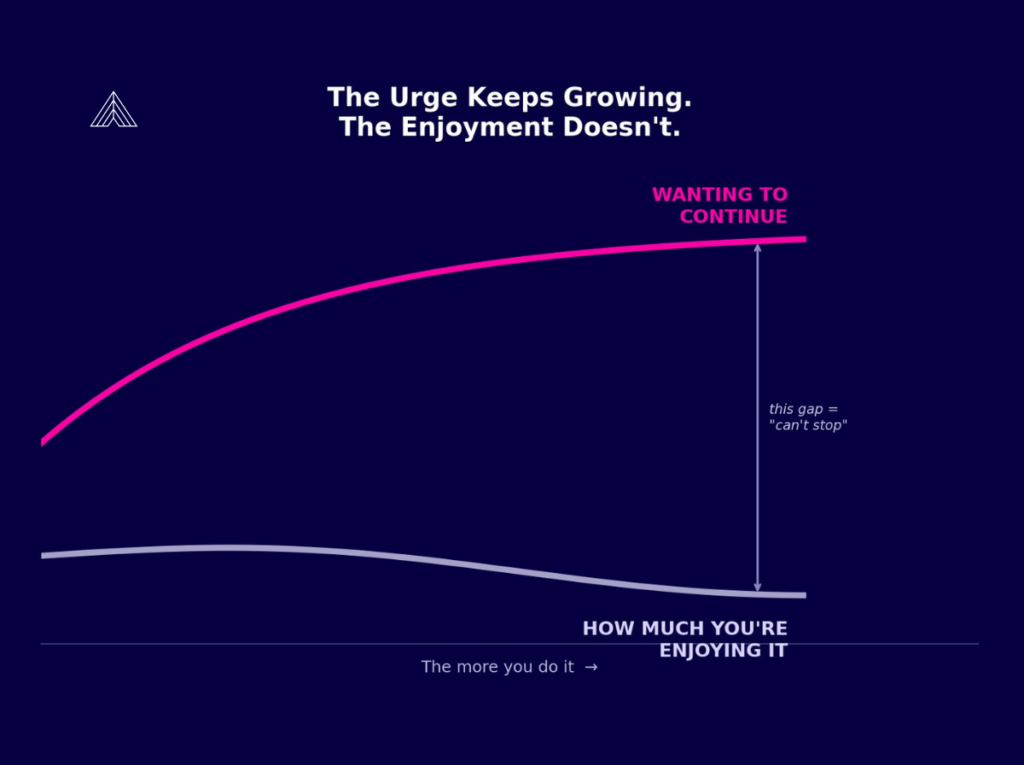
For years, dopamine was treated as the brain’s “pleasure chemical.” Neuroscientist Kent Berridge’s research, done over more than two decades at the University of Michigan, showed that wasn’t quite right. Berridge and colleague Terry Robinson found that dopamine drives wanting, not liking — what they call incentive salience. It’s the system that motivates pursuit of a reward. A separate, opioid-based system governs the actual pleasure once the reward arrives.
Under normal conditions, wanting and liking move together — you want a reward roughly in proportion to how much you’ll enjoy it. But Berridge and Robinson’s incentive-sensitization theory shows that in compulsive patterns, the two systems split apart. Wanting keeps intensifying — the pull to check, refresh, keep going, do one more round — even as the liking, the actual satisfaction, stays flat or declines.
That split is why “can’t stop” often isn’t about enjoyment at all. It’s a motivational system firing independently of the reward it was originally built to chase.
Is That the Same Mechanism as Flow?
Not quite, and the distinction matters for anyone managing their own workload. Flow — the state psychologists describe as complete, effortless absorption in a task with clear goals and immediate feedback — is a wanting versus liking system working in sync. It ends. It’s followed by satisfaction, not withdrawal.
Compulsive “can’t stop” behavior looks similar from the outside — someone glued to a screen, unwilling to break — but the internal experience is different. The wanting circuit keeps firing on cue exposure alone: a notification, a new metric, one more data point, regardless of whether the activity is still producing anything of value. Where flow ends in satisfaction, this pattern tends to end in depletion.
The practical distinction: flow makes work better. Unregulated wanting makes work longer, without making it better.
What Does This Mean for How a Workday Should Actually Be Structured?
Both patterns respond to structure, not effort. Psychologist Peter Gollwitzer’s research on implementation intentions — deciding in advance exactly when, where, and how a specific task will start — has repeatedly shown it reduces the gap between intention and action, precisely the gap where amygdala-driven avoidance takes hold. A vague intention to “start the proposal today” gives the threat response room to win. A specific one — open the document at 9am, at the desk, before checking email — gives it far less.
For the opposite problem, the fix runs in the other direction: building in deliberate stopping points before the wanting circuit gets a chance to override judgment. A scheduled end time. A colleague who asks the closing question. A calendar block that ends the working session regardless of how compelling the next fifteen minutes feels.
Neither intervention requires more willpower. Both work by changing the decision architecture the brain is reacting to — the setup around a choice, not the willpower behind it. That’s the more reliable lever, in the end.
Neither procrastination nor compulsive overworking is a character flaw. Both are the same brain protecting you from two different kinds of threat.
The Final Thought
The same organ that keeps a professional frozen in front of a blank proposal can, an hour later, keep a different professional unable to close the laptop. Understanding which circuit is actually running in a given moment is the difference between fighting the wrong problem and fixing the real one.
At Neuro Business School, the Executive Neuro MBA is built around exactly this kind of applied behavioral science — understanding the mechanisms behind decisions, not just the outcomes. The program is available fully online, for people building a business around real decisions, not textbook ones.
Sources
• Pychyl, T. A., cited in “What happens in the brain when we procrastinate,” National Geographic, 2026.
• Steel, P. (2007). The nature of procrastination: A meta-analytic and theoretical review of quintessential self-regulatory failure. Psychological Bulletin, 133(1), 65–94.
• Sirois, F. M., & Pychyl, T. A. (2013). Procrastination and the priority of short-term mood regulation: Consequences for future self. Social and Personality Psychology Compass, 7(2), 115–127.
• Berridge, K. C. (2007). The debate over dopamine’s role in reward: the case for incentive salience. Psychopharmacology, 191(3), 391–431.
• Robinson, T. E., & Berridge, K. C. (2025). The incentive-sensitization theory of addiction 30 years on. Annual Review of Psychology, 76, 29–58.
• Gollwitzer, P. M. (1999). Implementation intentions: Strong effects of simple plans. American Psychologist, 54(7), 493–503.