

Photo: Simon Hattinga Verschure / Unsplash, edited by Neuro Business School
Every company says it wants to “hire for AI.” Almost none of them mean the same thing by it.
Here’s the number that reframes the search: 88% of organizations already use AI in at least one business function. Only about 39% see any bottom-line impact from it, according to McKinsey’s 2025 State of AI survey. The gap isn’t the models. It’s what happens after the model gets built.
That’s what a Master in Artificial Intelligence should actually train you for. Not writing more code, but deciding which problems are worth solving with AI, and helping an organization trust the answer enough to use it.
What this article covers:
🎯 Why “can you build a model” stopped being the interesting hiring question
📉 What’s actually happening to the technical AI skills gap
🧭 What a Master in Artificial Intelligence trains that a coding bootcamp doesn’t
🧠 The 20% of the program that isn’t about AI at all, and why it’s there
💼 Where graduates of programs like this actually land
Why Did “Can You Build a Model” Stop Being the Interesting Question?
AI tools now draft a working model faster than most junior hires could a year ago. That’s not a small shift. The skill that used to be scarce, the ability to produce a model at all, isn’t the bottleneck anymore. The bottleneck moved upstream, to deciding what’s worth building in the first place.
Almost nobody prepares for that decision on purpose. Most AI education still assumes the hard part is the model.
What Are Companies Actually Hiring For Right Now?
AI Strategist, AI Product Manager, and Digital Transformation Consultant have grown alongside, and in some sectors faster than, Machine Learning Engineer roles. None of the three require writing production code day to day. All three require someone who can translate between a technical team, a leadership team, and whatever the AI system is supposed to change.
That translation role is where a Master in Artificial Intelligence earns its place next to a computer science degree, not instead of one. The technical foundation still matters: data science, machine learning, automation. But it’s built specifically to be usable by someone who also has to sit in the room where a CFO asks whether the investment is worth it.
What Does a Master in Artificial Intelligence Actually Teach, Beyond the Technical Core?
Programs built around AI for business typically split roughly 80% applied technical work, 20% strategy — data science foundations, machine learning and predictive analytics, generative AI and automation tools on one side; on the other, how AI actually gets adopted or rejected inside a real organization, how to build an AI strategy that survives a budget meeting, and how to lead a team through the kind of change AI tends to force.
It’s the second half of that split, not the model-building, that maps most directly onto the roles actually growing in the market.
Why Is There Neuroscience in an AI Program at All?
Here’s the part that sounds unrelated until it isn’t.
AI adoption inside companies fails less often because the model is wrong,
and more often because people don’t trust it enough to use it.
That resistance follows recognizable patterns: status threat, loss of perceived control, distrust of a decision nobody can fully explain. A 2015 study on algorithm aversion found that people avoid relying on an algorithm after watching it make even one mistake, even when it still outperforms a human. Understanding that pattern is a neuroscience and behavioral question as much as a technical one, and it’s exactly the kind of thing a purely technical AI program has no reason to cover.
A program that pairs AI strategy with applied neuroscience teaches the adoption problem directly, not as an afterthought. Someone who can build the model and anticipate why a team might quietly ignore it is doing a different job than someone who can only do the first part.
Where Do Graduates Actually Land?
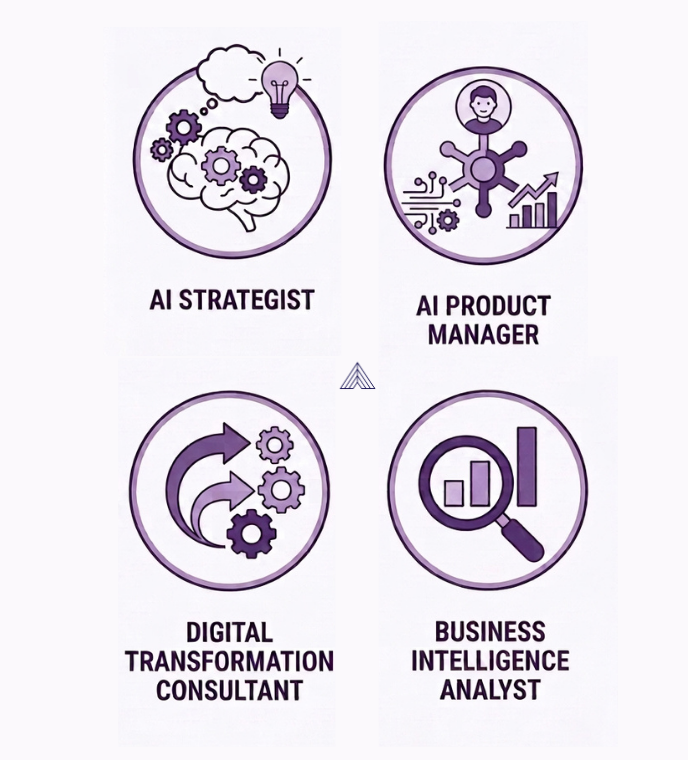
The honest version of this question isn’t “will I get a job in AI.” Demand across the field is strong enough that the answer is usually yes. It’s which job. Career paths tied to this kind of program tend to cluster around roles like AI Strategist, AI Product Manager, Business Intelligence Analyst, and Digital Transformation Consultant, alongside more technical tracks like Data Scientist or Machine Learning Engineer for graduates who want to stay closer to the model itself.
Employers are paying for judgment about where AI belongs in a business, not just for the ability to produce it.
The Master in Artificial Intelligence at Neuro Business School is built around exactly this gap: 80% applied AI and data science, 20% strategy, neuroscience, and innovation — for people who want to lead AI decisions, not just execute them. The program is available fully online, for professionals who don’t have the option to pause a career to build this skill set.
Sources
- Dietvorst, B. J., Simmons, J. P., & Massey, C. (2015). Algorithm aversion: People erroneously avoid algorithms after seeing them err. Journal of Experimental Psychology: General, 144(1), 114–126.
- McKinsey & Company (2025). The State of AI: Global Survey 2025 — 88% of organizations use AI in at least one function, but only ~39% report any EBIT impact from it.
- BCG (2026). Why AI Change Is Actually a People Change — on adoption and trust as the primary bottleneck in enterprise AI rollouts, not model performance.
- LinkedIn (2026). Jobs on the Rise 2026 — AI Engineer ranked #1 fastest-growing U.S. job title; AI Consultant/Strategist ranked #2, with most people moving into that role from product management backgrounds.
- Neuro Business School, Master in Artificial Intelligence program data: curriculum structure, career outcomes, and employability figures.