


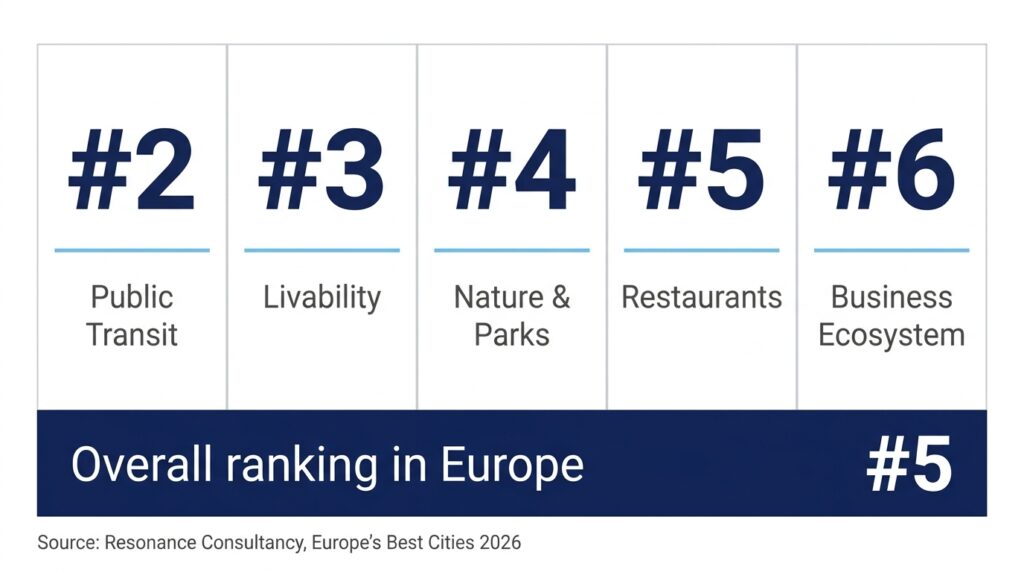
Most cities claim to be good places to study. Barcelona has independent data to back it up. According to StartupBlink’s Global Startup Ecosystem Index, 5th in the EU for startup ecosystems — behind Paris, Berlin, Stockholm, and Amsterdam — for the second consecutive year. And according to Resonance Consultancy’s Europe’s Best Cities 2026 ranking, 5th in Europe overall, evaluated across livability, cultural infrastructure, and economic strength. Two independent methodologies, the same result.
That matters for business education in a specific way. Studying in a city with an active, growing business ecosystem is different from studying in a city that merely has prestigious institutions. The former puts the classroom material within walking distance of the companies applying it.
This is not an argument that Barcelona is the only good city for business education. It’s an argument that the combination of factors it offers in 2026 is unusually strong — and worth understanding before you decide where to go.
What this article covers:
- Why Barcelona’s business ecosystem creates an unusual learning environment
- The cost and quality of life argument compared to other major European study cities
- Why the city’s geographic and cultural position matters for international networking
- What to consider beyond the rankings when choosing a business school location
Is Barcelona’s Business Reputation Actually Deserved?
The short answer is yes — and it has been for longer than the ranking lists suggest. Barcelona became Spain’s dominant startup hub partly by geography, partly by policy, and partly because it was already a city that international professionals wanted to live in. Those three factors compound.
According to StartupBlink’s index, Barcelona’s ecosystem currently counts 2,558 startups and over $1.8 billion in total startup funding. The 22@ innovation district, built on the former industrial land of Poblenou, anchors much of this activity — housing over 1,500 companies including headquarters and innovation offices for multinationals across tech, biotech, and fintech. The Mobile World Congress, the world’s largest mobile technology event, has been held in Barcelona since 2006. According to Catalonia Trade & Investment, Catalan startups now generate €2.33 billion in aggregate revenue, with the startup count having more than doubled since 2016.
None of this means a business school located here automatically produces better graduates. What it does mean is that internships, company visits, guest speaker programs, and post-program professional networks are qualitatively different when your campus is embedded in a city where these industries are actually operating.
Almost nobody weighs this seriously when choosing a business school. They look at rankings and tuition fees. The professional context of the city only becomes visible later.
Two independent rankings. Two different methodologies. Barcelona ranks 5th in Europe in both. That is not a coincidence.
Does the Cost of Living Actually Hold Up Against Other European Cities?
Barcelona sits in an interesting middle position. It is significantly cheaper than London, Amsterdam, or Paris as a place to live as a student or young professional, but more expensive than smaller Spanish cities. For international students from the US, UK, or Northern Europe, the comparison is usually favourable.
Monthly living costs for a student in Barcelona currently run between €850 and €1,400, including accommodation, food, transport, and basic expenses — comparable to many mid-tier German cities, and substantially below London. Public transport is well-integrated, with a dense metro, rail, and tram network that makes car ownership unnecessary. The city’s food market culture makes eating well on a budget more realistic here than in most European capitals.
The quality-of-life factors that don’t appear on cost calculators are significant. Resonance Consultancy’s Europe’s Best Cities 2026 report ranks Barcelona 5th overall in Europe, with particular strength in livability — a category that encompasses walkability, public transit, nature and parks, and air quality. The combination of Mediterranean climate, cultural infrastructure, and walkable urban density creates a student environment that is genuinely different from a campus in a smaller city or a colder capital.
Why Does Geographic Position Matter for Business Networking?
Barcelona’s position at the intersection of Southern Europe, Latin America (by culture and language), and the Mediterranean business corridor creates a networking context that is structurally different from studying in a Northern European capital. Spain’s private universities have become a particularly strong draw for international graduate students: according to ICEF Monitor, the number of international master’s students at Spanish universities has tripled over the past decade, with growth concentrated at private institutions. At Neuro Business School, that mix is visible in the classroom — students arrive from across Europe, the Americas, and beyond. The result is a peer group whose geographic spread is unusual even by European standards.
This matters less in the classroom and more in the professional life that follows it. The contacts you develop while studying in Barcelona tend to have wider geographic spread than those from a more domestically-oriented city. For programs that deal with behavioural science and AI — disciplines with genuine global commercial application — the diversity of professional perspective in that peer group has measurable value.
Barcelona also maintains a specific cultural relationship with Latin American markets that gives it commercial relevance beyond Europe. Spanish multinationals with significant LATAM operations tend to have offices or operational hubs here. For students with commercial interests in that region, proximity matters.
What Makes a City Good for Business Education Beyond Rankings?
Rankings measure institutions. They are a reasonable proxy for program quality, accreditation, and faculty calibre. What they do not measure well is real professional proximity — how close the campus is, literally and figuratively, to the industries and networks that will determine what happens after graduation.
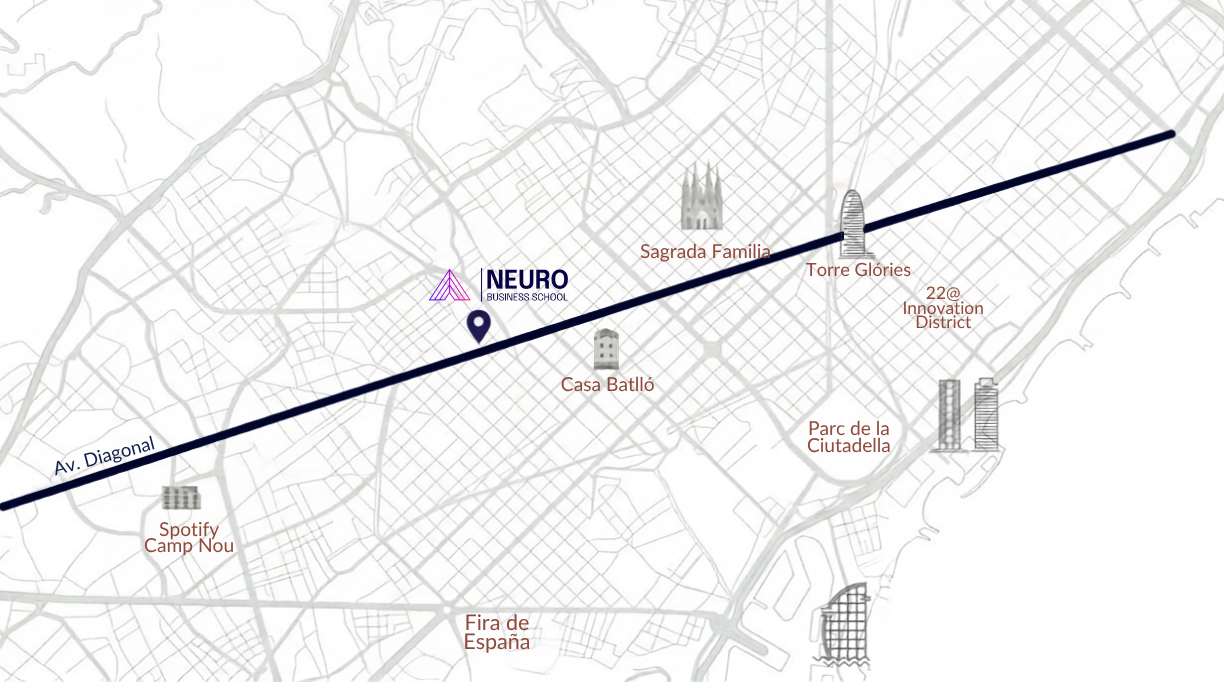
In Barcelona, that proximity is unusually high. The Diagonal corridor — the main axis of the city’s business and financial activity — runs through the Sarrià-Sant Gervasi district and connects the traditional banking and corporate headquarters in the upper city with the technology and creative industries closer to the seafront. Being based on or near this corridor puts students within direct reach of Barcelona’s business geography, not just its institutional one.
The city’s conference calendar adds another layer. Barcelona hosts more major international business events per year than most European cities outside London — Mobile World Congress, the Smart City Expo, the Barcelona Deep Tech Summit. For students with the presence of mind to attend these events rather than just read about them, the access is unusual.
This is obvious in retrospect. The location shapes the network. The network shapes the career. Most people figure this out after they’ve already chosen.
Is Barcelona the Right City for You?
The honest version of this question is more specific than it sounds. Barcelona is a strong choice if you want to study business in a city where the subject matter is happening around you, where your peer group will be genuinely international, and where the cost-quality ratio is competitive by European standards. It is less obviously the right choice if you want the relative quiet of a smaller university city, or if your professional network is primarily domestic and local placement matters more than international exposure.
For programs that deal specifically with how the brain drives business decisions — how consumers decide, how organisations behave under pressure, how marketing actually works at the neurological level — a city of this complexity and commercial density provides a live case study that a quieter location cannot.
Neuro Business School’s campus is located on Av. Diagonal in the Sarrià-Sant Gervasi district — directly within the business corridor described above. The school’s programs in neuromarketing, neurobusiness, and AI are available on campus in Barcelona for students who want the full immersive version: surrounded by peers working through the same material, in a city actively using it.
The City as Argument
Barcelona does not need the rankings to make its case for business education, though they help. What makes it unusual in 2026 is the combination: a startup ecosystem with over 2,500 active companies and growing, a cost of living that remains manageable against Northern European alternatives, a geographic position that generates a specific kind of international network, and a physical density that makes the professional world accessible rather than theoretical.
The question worth asking about any city for business education is not just where the best professors are. It is what the city itself teaches you, by proximity and by immersion, before you have even opened a textbook.
For context on what studying neuroscience-based business disciplines in this environment looks like in practice, the Master in NeuroMarketing, Master in NeuroBusiness, Master in AI, and Executive Neuro MBA programs are all available on campus. More at eunbs.com.
Sources
1. StartupBlink / Catalonia Trade & Investment (May 2025). Barcelona ranks among the top 5 EU startup hubs for the second consecutive year. catalonia.com. Source for EU 5th place ranking, 2,558 startups, $1.8B funding figures. https://catalonia.com/w/barcelona-ranks-among-the-top-5-eu-startup-hubs-for-the-second-consecutive-year
2. Resonance Consultancy (March 2026). Europe’s Best Cities 2026. worldsbestcities.com. Barcelona ranked 5th in Europe. https://www.worldsbestcities.com/rankings/europes-best-cities/
3. Catalonia Trade & Investment (2025). Startup ecosystem in Catalonia: key figures. catalonia.com. €2.33 billion aggregate revenue, 2,285 startups, +110% growth since 2016. https://catalonia.com/w/barcelona-ranks-among-the-top-5-eu-startup-hubs-for-the-second-consecutive-year
4. ICEF Monitor (February 2026). Inside Spain’s growing appeal for international students. monitor.icef.com. International master’s student tripling at Spanish private universities.
5. universityliving.com (2026). Cost of Living in Barcelona for Students. Monthly cost range €850–€1,400 — practical guide, not peer-reviewed; treat as indicative.