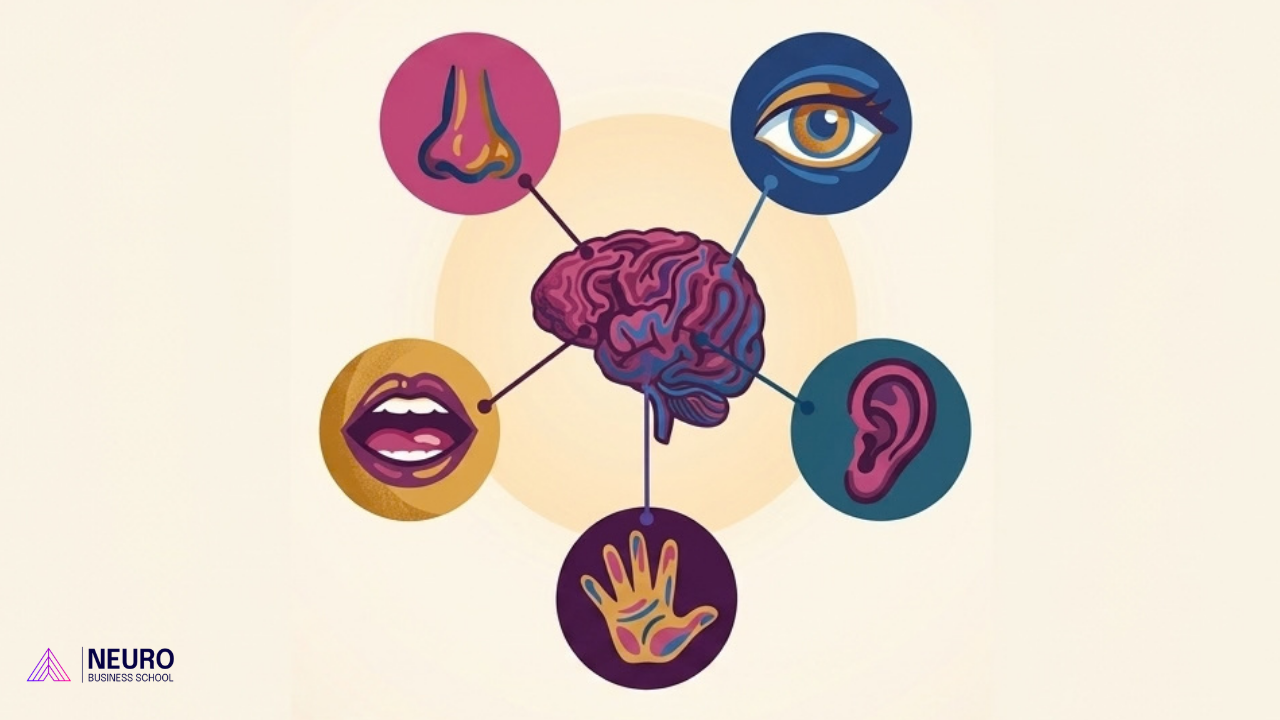

Hermès has a waitlist for a bag that costs more than a car. Chanel famously refuses to sell its core products online. Rolex produces fewer watches than the market demands — deliberately. None of this is bad business strategy. It is applied neuroscience, executed with more precision than most academic marketing programs ever teach.
The luxury industry did not discover behavioural science by reading papers. It discovered it by watching what actually moves people — then systematically building those triggers into product design, pricing architecture, retail environments, and brand communication. What academic marketing is only now formalising with fMRI studies and lab experiments, luxury houses have been running as operational strategy for more than a century.
The gap is worth examining. Not to admire luxury brands, but to extract the principles they have field-tested at scale — and to understand why those principles work at the level of brain biology.
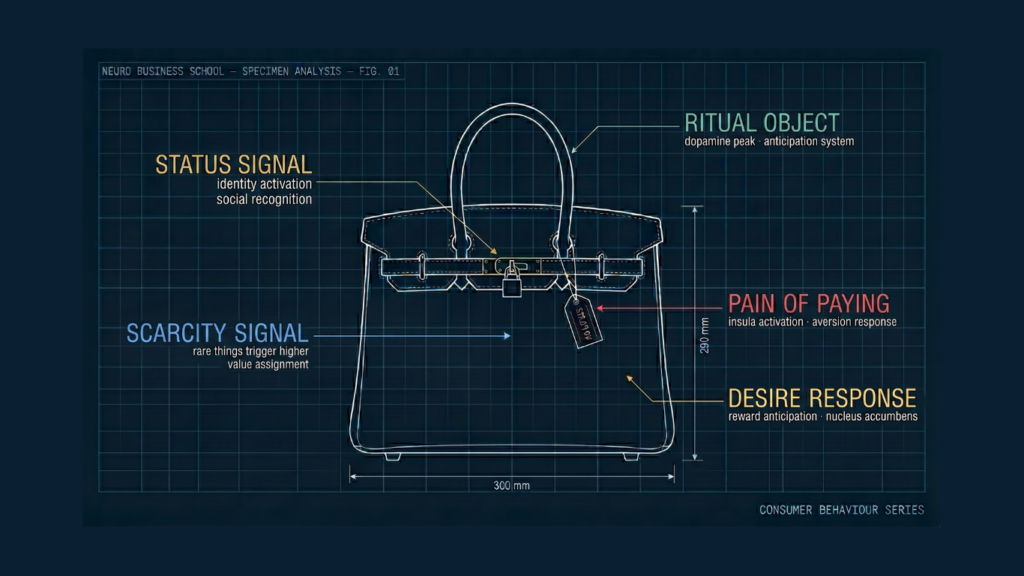
What this article covers:
- • Why price activates a pain response — and how luxury brands suppress it
- • What “price as a quality signal” means in the brain, backed by peer-reviewed research
- • How scarcity and ritual exploit the anticipation system
- • Why multisensory environments alter what buyers believe a product is worth
- • The one principle luxury brands never compromise — and what that tells us about identity
Why Does Paying for Something Literally Feel Like Pain?
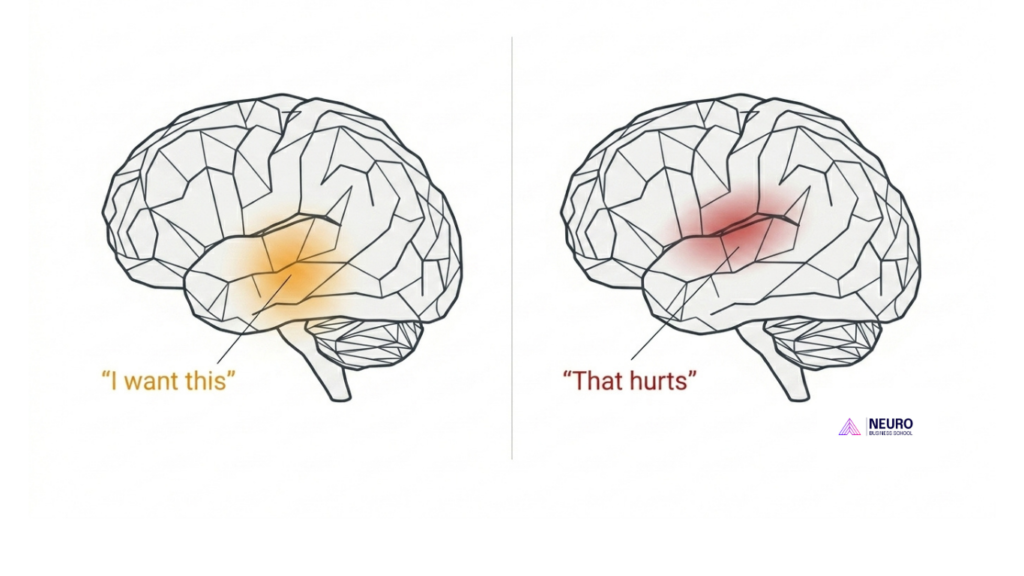
In 2007, a research team from Stanford and Carnegie Mellon used fMRI scanning to study what happens in the brain during purchasing decisions. They found something counterintuitive: the moment participants saw a price they perceived as excessive, the insula fired — the same neural region activated by physical discomfort and social rejection. They called this the pain of paying, and it reliably predicted whether someone would purchase or walk away.
This is not a metaphor. Parting with money activates a genuine aversion response in the brain before the conscious mind has finished evaluating whether the price is fair. The aversion fires first.
Luxury brands solve for this directly. The Hermès buying process is notoriously opaque — you cannot simply walk in and purchase a Birkin. The Rolex website does not show prices. Apple stores have no checkout counters; payment happens on a device held by a human being who comes to you. In every case, the design principle is identical: separate the moment of desire from the moment of payment. Reduce the salience of price. Let the limbic system encode the product before the insula has something to object to.
Almost nobody teaches this in a marketing course. And yet every luxury house in the world practices it.
Does a Higher Price Actually Change How Something Tastes?
It does — and the mechanism is neural, not just psychological. In a peer-reviewed study published in PNAS, Hilke Plassmann and colleagues at Stanford asked participants to taste wines they were told cost different amounts, while lying in an fMRI scanner. The wines were identical. The participants who thought they were drinking more expensive wine reported higher enjoyment — and showed stronger activity in the medial orbitofrontal cortex, a region associated with experienced pleasure. A follow-up study by the same research group confirmed the finding with a different design.
This is what researchers now call the marketing placebo effect: a measurable, neurological change in experienced quality, produced entirely by price information. The price signal does not just influence what you think about a product. It changes what you actually experience when you consume it.
Luxury brands have operated on this principle without ever calling it that. price as a quality signal is not a cynical tactic. It is a feature of how the brain processes value. A Chanel suit and an identically constructed suit at a third of the price are not the same product to the brain — even if they are the same object to the eye. The price is part of the product.
The implication for non-luxury brands is uncomfortable: if you discount habitually, you are not just lowering margin. You are neurologically training your buyers to experience your product as worth less.
Price is not what you charge. It is what the brain uses to decide what the experience will feel like before it begins.
Why Does Scarcity Feel Like Urgency — Even When You Know It’s Manufactured?
The Hermès allocation system, Supreme’s drop calendar, the Rolex “production shortfall” — these are not supply chain problems. They are neurological architecture. When something appears genuinely scarce, the brain assigns it higher value through the scarcity heuristic, a cognitive shortcut documented by Robert Cialdini and embedded in decades of consumer research. Rare things, in the environment where human cognition evolved, were worth acting on. The reflex stuck.
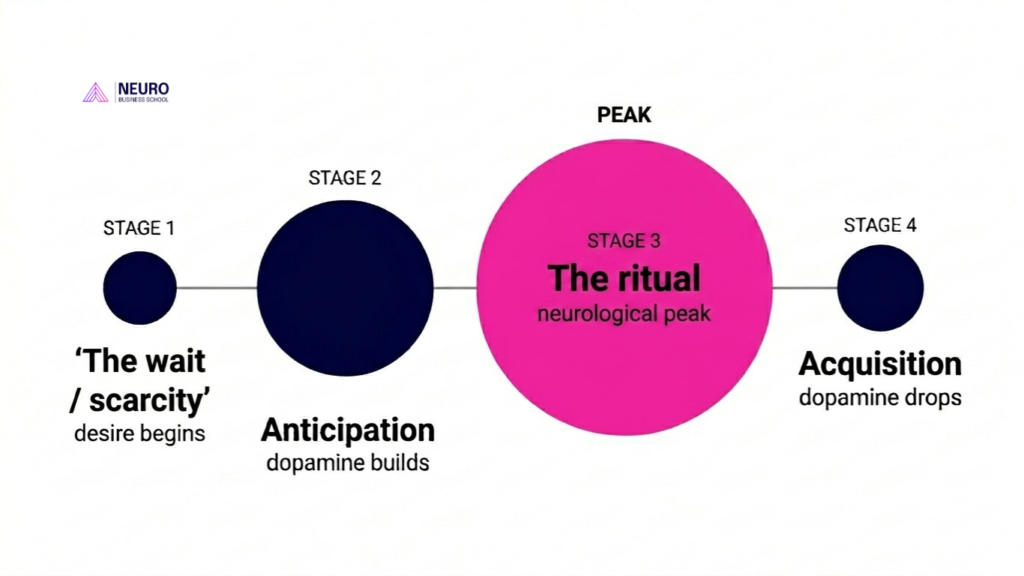
What luxury brands add to this is anticipation. The waitlist is not just a supply mechanism — it is a dopamine delivery system. Wolfram Schultz’s foundational research on reward processing showed that dopamine neurons respond most strongly to cues that predict reward, not to the reward itself. The anticipation state is the neurological peak. Luxury brands extend and ritualise that state deliberately.
The unwrapping ritual at Chanel. The orange box at Hermès. The white gloves used by sales associates at some auction houses. Each of these is a designed anticipation ramp — a sequence of sensory cues that prolongs the dopamine build-up before the moment of acquisition. The product is, in a real sense, secondary to the system built around it.
This is obvious in retrospect. It is also the reason that removing these rituals from a luxury brand — in the name of efficiency or modernisation — reliably destroys value.
Why Does the Environment Change What Something Feels Worth?
When Louis Vuitton redesigned its flagship stores to include architectural features that evoke heritage, material surfaces that respond to touch, and lighting calibrated to specific product presentations, this was not interior decoration. It was sensory congruence — the deliberate alignment of environmental signals with the quality cues the brain uses to estimate product value.
Research in the Journal of Marketing by Shahid and colleagues confirmed what luxury retailers had long understood: sensory marketing cues and brand experiences directly produce emotional attachment and brand loyalty, with physical environment acting as a moderating variable. A product displayed in a certain way, in certain conditions, with certain ambient signals, is literally experienced as a different product.
The brain does not evaluate products in isolation. It evaluates them in context. Luxury retail environments are context engineering — every element from the scent to the music tempo to the lighting angle is chosen to push the brain’s valuation system in a specific direction. University marketing programmes rarely teach students how to design these systems from first principles. Luxury brands employ neurological consultants who do nothing else.
Why Do Luxury Buyers Defend Prices They Cannot Rationally Justify?
There is a phenomenon in social psychology called identity-protective cognition: people process information differently when a belief is tied to their self-concept. When a luxury product becomes part of how someone understands who they are, rational price challenges activate a defensive response rather than a recalculation.
This is why luxury marketing that leads with rational quality arguments almost always underperforms messaging built around aspiration, heritage, and identity. The brain is not weighing up features versus price. It is defending a version of itself. Research in the Journal of Consumer Research found that luxury purchases shifted buyers’ internal self-concept — their reported feelings of social power and competence — independently of how others perceived them. You do not buy the bag. You buy who you believe you are when you carry it.
The practical implication: mental availability — being the brand that comes to mind when a buying moment arrives — is not just about reach or frequency. For luxury, it is about which identity is being activated. The brands that dominate this space are the ones whose names are embedded in aspirational self-narratives that buyers hold privately, long before a purchase is made.
What Should Non-Luxury Brands Actually Take From This?
The lesson from luxury neuromarketing is not “charge more and make things scarce.” It is: your buyers’ experience of your product is not fixed. It is constructed in the brain from a combination of price signals, environmental cues, anticipation architecture, and identity resonance. Luxury brands design every one of these variables with intention. Most other brands design almost none of them.
Every decision that reduces friction in a way that also reduces perceived value is a trade-off that should be made deliberately, not by default. Every habitual discount is a bet that short-term conversion is worth training buyers’ brains to wait. Every generic retail environment is a missed opportunity to let context do some of the selling.
The neuromarketing principles behind luxury strategy are not exclusive to luxury products. They are properties of how human brains assign value. Understanding them at the level of mechanism — not just as marketing rules of thumb — is what separates brand architects from brand managers.
These are the questions that Neuro Business School’s Master in NeuroMarketing is built around — available fully online, for professionals who want to understand the science behind why campaigns work, not just whether they do.
Sources
- Knutson, B., Rick, S., Wimmer, G.E., Prelec, D., & Loewenstein, G. (2007). Neural predictors of purchases. Neuron, 53(1), 147–156. Peer-reviewed. The “pain of paying” insula activation finding comes from this study, not from a Carnegie Mellon study alone — it is a Stanford/Carnegie Mellon/MIT collaboration. The study is published in Neuron, one of the top neuroscience journals.
- Plassmann, H., O’Doherty, J., Shiv, B., & Rangel, A. (2008). Marketing actions can modulate neural representations of experienced pleasantness. PNAS, 105(3), 1050–1054. Peer-reviewed. The wine/fMRI study — confirmed by Schmidt, Skvortsova, Kullen, Weber, & Plassmann (2017) in Scientific Reports. “Marketing placebo effect” terminology from Plassmann’s subsequent INSEAD research.
- Cialdini, R.B. (1984). Influence: The Psychology of Persuasion. Harper Collins. Scarcity heuristic — applied research synthesis, not a single controlled experiment.
- Schultz, W., Dayan, P., & Montague, P.R. (1997). A neural substrate of prediction and reward. Science, 275(5306), 1593–1599. Peer-reviewed neuroscience. Dopamine as anticipation signal, not reward signal.
- Shahid, S., Paul, J., & Gilal, F.G. (2022). The role of sensory marketing and brand experience in building emotional attachment and brand loyalty in luxury retail stores. Psychology & Marketing, 39(7), 1933–1948. Peer-reviewed. Conducted across Chanel, Dior, Louis Vuitton, Gucci, Burberry, and other luxury retailers.
- Han, Y.J., Nunes, J.C., & Drèze, X. (2010). Signaling status with luxury goods: The role of brand prominence. Journal of Marketing, 74(4), 15–30. Peer-reviewed. Identity and signaling in luxury consumption.
- Kahneman, D. (2011). Thinking, Fast and Slow. Farrar, Straus and Giroux. System 1/System 2; value construction; contextual framing effects on experience.