

61% of Spanish companies have already implemented some form of artificial intelligence. Of those, 44% report making faster decisions as a result, according to a study by Amazon Web Services presented at AWS Summit Madrid 2026. Neurostrategy is the discipline that exists precisely so those decisions aren’t just faster, but better: it combines neuroscience, artificial intelligence, and strategic thinking to understand how organizations actually decide, and how they should.
Most companies have already invested in the technology. Almost none have invested in training the people who use it to decide. That’s exactly the gap Neuro Business School’s Master in Neurostrategy and Artificial Intelligence exists to close: it covers both the technical foundations of AI and the strategy to direct it.
What Is Neurostrategy, Exactly?

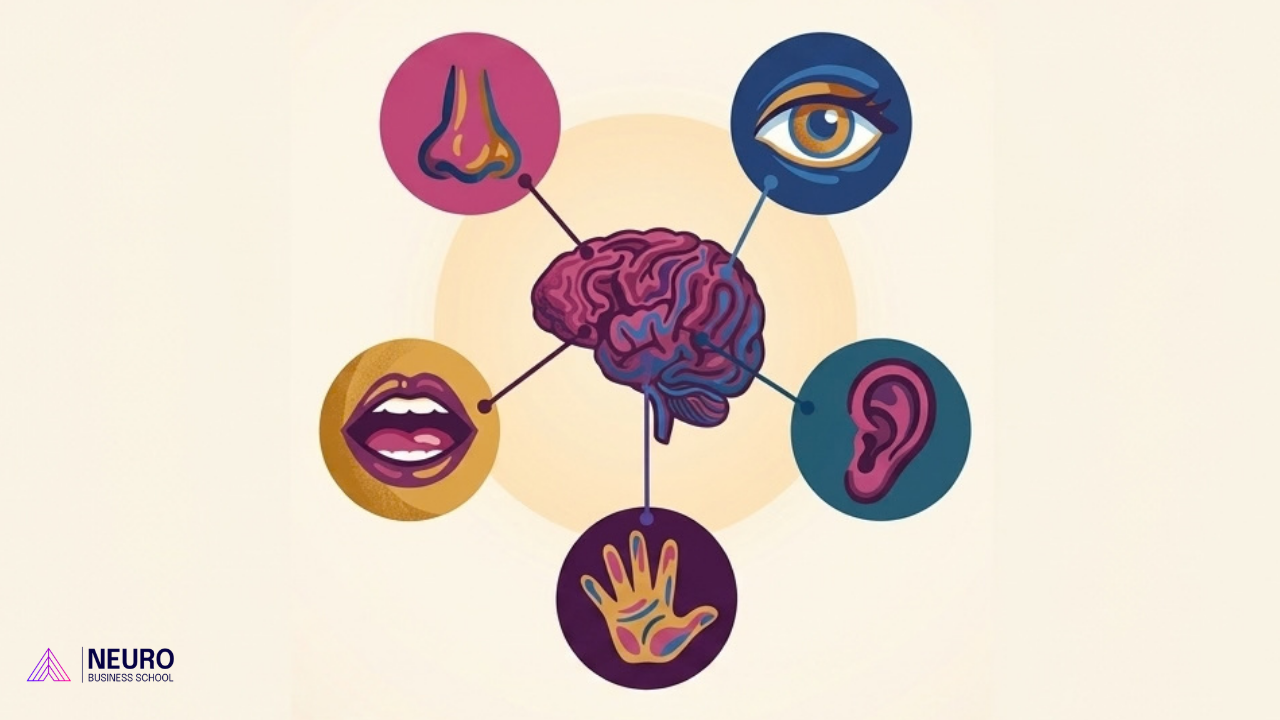
Image by DC Studio on Magnific, modified by NBS
Most important business decisions, like launching a product, entering a market, letting someone go, or setting a price, aren’t made as rationally as the person making them believes. Cognitive biases, loss aversion, decision fatigue: all of that happens in the boardroom too, not just in the consumer’s head.
Neurostrategy applies what neuroscience and behavioral economics know about how the human brain actually decides, and pairs it with the AI tools that now let organizations process data at a scale no single executive could handle alone. It isn’t neuroscience on one side and technology on the other. It’s one discipline.
Almost nobody designs their decision-making processes around how a brain actually decides. That’s the blind spot this discipline exists to close.
Why Doesn’t AI Alone Improve Business Decisions?
The same study has a catch: even though 61% of Spanish companies already use AI, 64% stay at basic use, mostly chatbots, and only 17% use it in a genuinely advanced way, combining multiple models or agentic AI strategically. The gap isn’t access to the technology. It’s judgment about how to use it.
Having the tool and knowing which decision to point it at, with what limits, and with what understanding of the human behavior behind it, are two different things. The second one is what this master’s trains.
What this means for your career: if you already work with data, teams, or strategy, the competitive edge over the next few years won’t be knowing that AI exists. It’ll be knowing how to direct it with judgment.
What Do You Actually Study in the Master in Neurostrategy and Artificial Intelligence?
The program is organized into 8 modules of 6 credits each, plus a 12-credit Master’s Final Project applying everything learned to a real business challenge:
| Module | What it covers |
|---|---|
| Module 1: Neuroscience Applied to Strategy | Fundamentals of neuroscience, attention/memory/learning, neuroplasticity, cognitive biases |
| Module 2: Neurostrategy and Decision-Making | Strategic thinking, neuroeconomics, decision-making under uncertainty, competitive strategy |
| Module 3: Artificial Intelligence for Business | Fundamentals of AI, Machine Learning, Deep Learning, applied use cases |
| Module 4: Generative AI and Business Automation | ChatGPT and intelligent assistants, Prompt Engineering, process automation |
| Module 5: Consumer Psychology and Behavioral Economics | Consumer behavior, behavioral economics, experience design |
| Module 6: Business Strategy and Innovation | Strategic management, Design Thinking, business models |
| Module 7: Leadership, Change Management, and NeuroLeadership | Neuroscience-based leadership, emotional intelligence, high-performance teams |
| Module 8: Strategic Consulting with AI | Solving real-world cases, business consulting, executive presentation |
| Master’s Final Project | Integrative project applying neurostrategy and AI to a real business challenge |
The path runs from foundations (applied neuroscience, cognitive biases, behavioral economics) through the more technical side of generative AI and automation, and ends in strategic consulting: presenting a real solution to a real business case.
What Career Paths Does This Master’s Lead To?
The program is designed to prepare people who can move between strategy, technology, and human behavior: not purely technical profiles, and not purely traditional business ones either. Among the specific career outcomes:
🔹 Chief Strategy Officer
🔹 Director of Digital Transformation
🔹 AI Business Strategist
🔹 Artificial Intelligence or Neurostrategy Consultant
🔹 Director of Innovation
🔹 Business Intelligence Manager
Can You Study This While Working Full-Time?
The master’s is 100% online and runs one academic year, built to be completed without stepping away from your current job. You don’t need to pause your career to understand how AI is changing the way companies decide. If anything, it’s better not to: what you learn each week applies directly to the job you already have, not to a hypothetical case.
A Final Thought
Artificial intelligence is already in most companies. What’s still missing, in most of them, is someone who can decide what to actually do with it, and why, with neuroscience as the foundation and strategy as the compass. That’s this master’s, in one sentence.
Explore the Master in Neurostrategy and Artificial Intelligence at Neuro Business School.
FAQ
Is the master’s 100% online?
Yes, the program is fully online, backed by Neuro Business School in Barcelona.
Do I need to know how to code?
No prior programming experience is required to enroll.
How long does the program last?
One academic year, structured across 8 modules plus the Master’s Final Project.
What language is it taught in?
The program is taught in Spanish. If you’d prefer to study in English, NBS also offers the Master in Artificial Intelligence, a separate program focused on applied AI for business.
When does the next intake start?
Upcoming intakes are October 2026, January 2027, and March 2027.
Sources
1. Amazon Web Services (AWS). “Unlocking AI’s potential in Spain in 2026,” presented at the 11th AWS Summit Madrid, 2026. Source for the 61% adoption figure, the 44% faster-decisions figure, and the 17% advanced-use gap.
2. Kahneman, D. (2011). Thinking, Fast and Slow. Farrar, Straus and Giroux. General reference on cognitive bias in decision-making.