
Walk into ten stores today and count how many actually smell like anything. Not bad, not overpowering -just present. Most retail spaces are functionally scentless, and most retailers have never once treated that as a decision.
Store layout gets a strategy. Lighting gets a strategy. Music gets a strategy. Smell usually gets whatever the cleaning products and the loading dock happen to produce that day. Which is strange, because out of everything a shopper senses, smell is the one sense that reaches the emotional, decision-making parts of the brain first
This article looks at why that happens, what a well-known casino experiment revealed about spending and scent, what a 30-year-old retail study still teaches about “neutral” spaces, and what some of the world’s biggest brands are doing about it on purpose.
What this article covers:
- 🧠 Why smell has a shortcut to the emotional brain that sight and sound don’t
- 🎰 What happened when a Las Vegas casino piped a specific scent into one gambling area
- 🏬 What a “neutral,” unscented store is quietly telling a shopper’s brain
- ✈️ Why some of the biggest brands in the world built a signature scent on purpose
- 💡 What this actually means for a business that isn’t an airline or a casino
Why Does Smell Skip the Line in Your Brain?
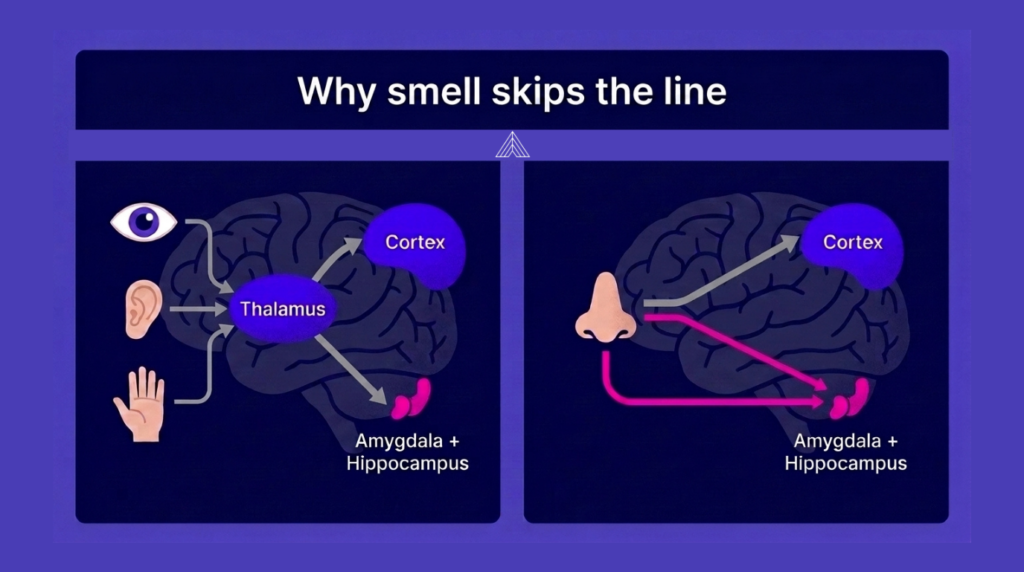
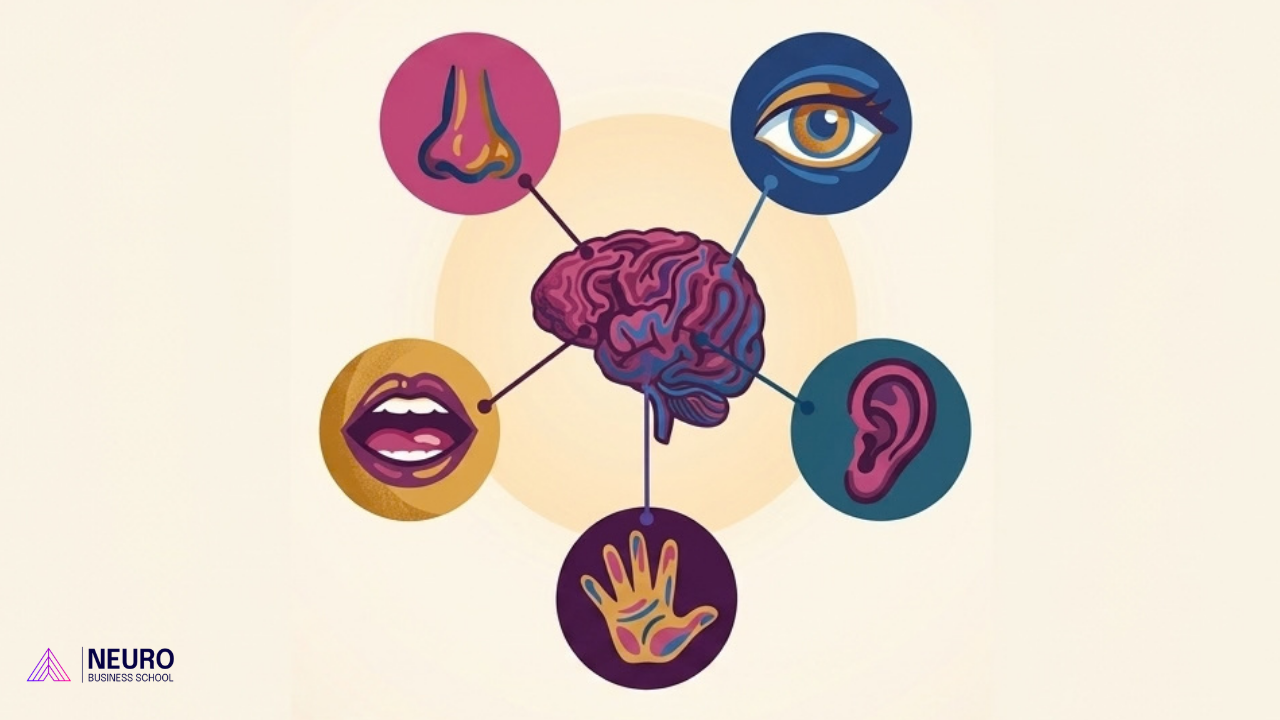
Sight and sound both make a stop before they reach the parts of the brain that handle emotion and memory. They’re routed first through the thalamus, the brain’s relay station, before continuing on to be interpreted.
Smell doesn’t make that stop. The olfactory bulb – a small structure tucked just behind the nose, the first stop for anything you breathe in – connects directly to the amygdala and the hippocampus – the regions most closely tied to emotion and memory. Researchers at Harvard’s Department of Molecular and Cellular Biology have described it plainly: olfactory signals reach the limbic system fast, because there’s no detour built into the wiring.
That’s the likely explanation behind what’s sometimes called the Proust effect – a smell pulling up a memory before you’ve consciously placed where it’s from. A particular hallway. A particular kitchen. It arrives whole, emotion attached, before you’ve worked out why.
Smell is the only sense wired with a direct line to memory and emotion —
everything else gets processed on the way.
What Happened When a Casino Smelled Like Something?
In 1995, researcher Alan Hirsch published one of the most cited real-world tests of ambient scent’s effect on spending. Over one weekend, two areas of slot machines in a Las Vegas casino were quietly scented with different odors, while a third area was left as an unscented control.
The result, published in Psychology & Marketing: gamblers in the area with the more effective scent put 45% more money into the machines than the same area had taken in the weekends before and after the test. The effect was strongest on the day the scent concentration was highest.
Nothing else changed. Same machines, same lighting, same layout. The only variable was what was in the air.
Does the Casino Effect Hold Up in a Regular Store?
A year later, researchers Spangenberg, Crowley, and Henderson tested something closer to ordinary retail. Writing in the Journal of Marketing in 1996, they built a simulated store and compared how shoppers evaluated it, and behaved in it, with a pleasant ambient scent present versus no scent at all.
Shoppers rated the scented store and its products more positively, even when the scent had nothing to do with what was being sold. That finding helped establish what’s now studied as sensory marketing — designing what customers feel, hear, and smell, not only what they see. A follow-up study a decade later found the effect gets even stronger when the scent matches the products on the shelves.
A pleasant, well-chosen scent doesn’t just make a store feel nicer. It measurably changes how people judge what’s for sale inside it.
What About Getting People Off the Bus and Into the Store?
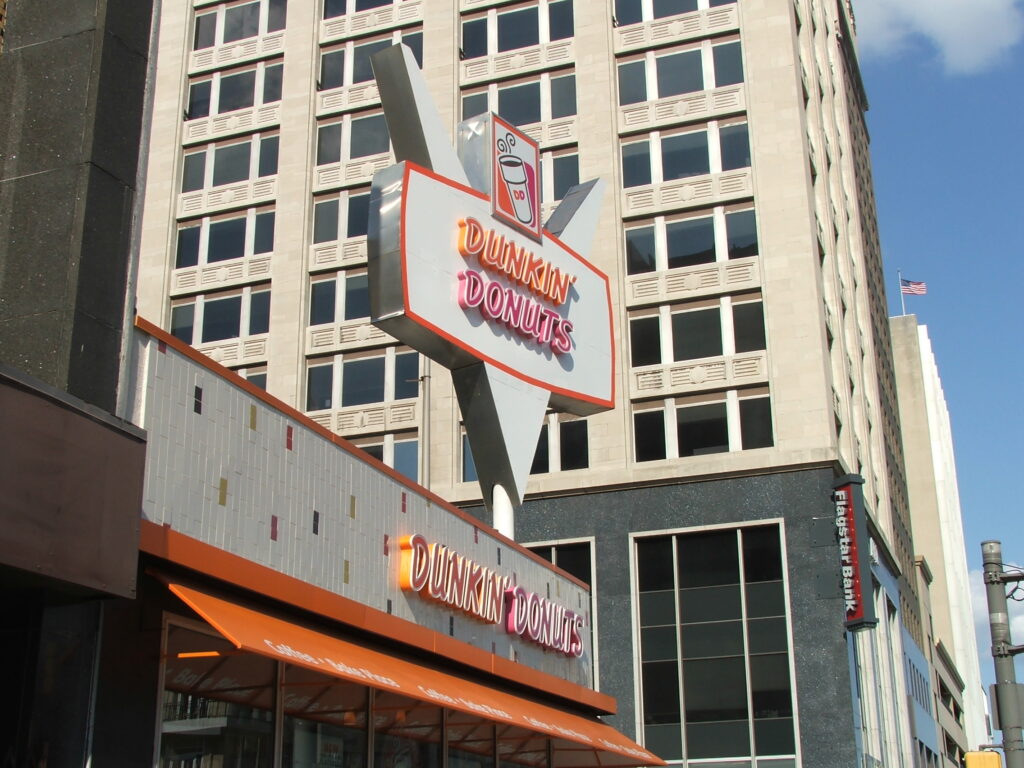
Dunkin’ Donuts, Downtown Indianapolis, by stallio, via Wikimedia Commons
In Seoul, Dunkin’ Donuts ran a campaign called “Flavor Radio.” Devices installed on city buses released the smell of coffee whenever the brand’s radio jingle played over the speakers, timed so riders smelled coffee right as they heard the ad.
Dunkin’ reported a 16% increase in visitors to stores near affected bus stops, and a 29% increase in coffee sales during the test period. Around 350,000 commuters were exposed to the campaign over several months.
It’s a marketing case study, not a lab experiment — but it points in the same direction as the casino and retail research above: pairing the right scent with the right moment moves real behaviour.
Why Do Some Brands Build Their Whole Identity Around a Smell?
Photo by Suhyeon Choi on Unsplash
Since the early 1990s, Singapore Airlines has used a signature fragrance, Stefan Floridian Waters, worn by cabin crew, infused into the hot towels served before takeoff, and diffused faintly through the cabin. Branding expert Martin Lindstrom, author of Brand Sense, has described its role less as something passengers consciously remember and more as something that quietly recalls the whole brand experience the moment they step on board.
That’s deliberate scent branding: treating a smell as recognisable an asset as a logo, and building it into the experience on purpose rather than leaving it to chance.
So What’s a “Neutral” Store Actually Costing?
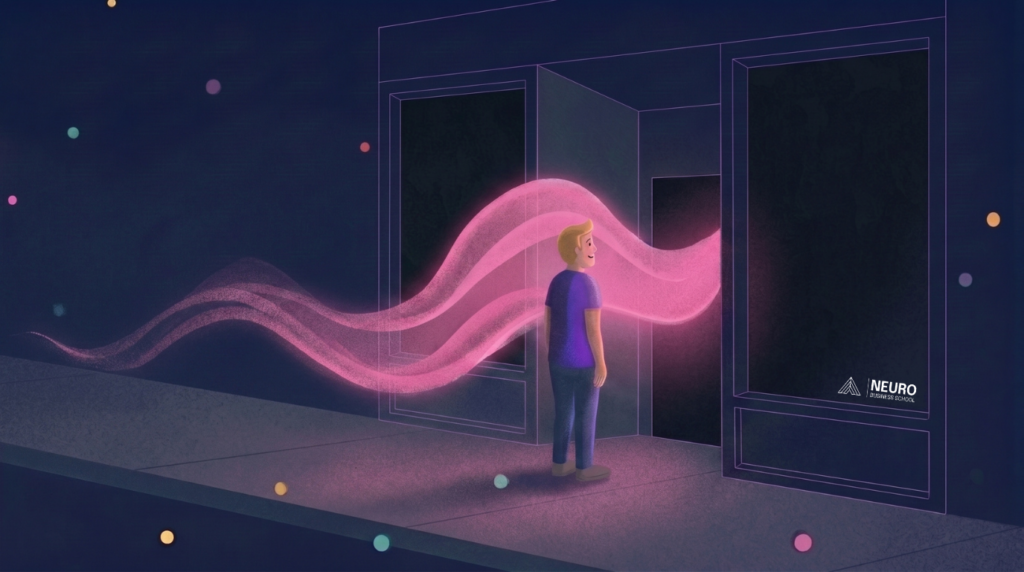
A store with no scent isn’t neutral to a shopper’s brain. Based on the research above, it may simply be forgettable. A pleasant ambient scent shifts how long people stay, how they rate the space, and — because of how directly smell connects to memory — how well they remember it later.
The brain doesn’t file “no smell” away as nothing. It just files the visit under something else — usually something less memorable.
Retailers already invest carefully in lighting, layout, and music. Leaving scent to whatever happens to be in the air is optimising four senses out of five and quietly ignoring the one wired most directly to memory and emotion.
The Master in NeuroMarketing at Neuro Business School covers sensory and multisensory marketing strategy in depth — the same principles behind the research above — and is available fully online for professionals who want to apply this directly to their own brand, store, or product line.
Sources
1. Hirsch, A. R. (1995). Effects of ambient odors on slot-machine usage in a Las Vegas casino. Psychology & Marketing, 12(7), 585–594.
2. Spangenberg, E. R., Crowley, A. E., & Henderson, P. W. (1996). Improving the store environment: Do olfactory cues affect evaluations and behaviors? Journal of Marketing, 60(2), 67–80.
3. Spangenberg, E. R., Sprott, D. E., Grohmann, B., & Tracy, D. L. (2006). Gender-congruent ambient scent influences on approach and avoidance behaviors in a retail store. Journal of Business Research, 59, 1281–1287.
4. Harvard Gazette (2020). “How scent, emotion, and memory are intertwined — and exploited.” Harvard Museum of Natural History / Harvard Brain Science Initiative panel.
5. Cleveland Clinic (2025). “Scent and Sensibility: The Link Between Smell and Memory.” Cleveland Clinic Health Essentials.
6. CNBC (2012) and Metro Magazine (2012), coverage of Dunkin’ Donuts’ “Flavor Radio” campaign, Seoul, South Korea (company-reported results).
7. Lindstrom, M., Brand Sense; coverage of Singapore Airlines’ “Stefan Floridian Waters” signature scent via CNN and industry press.