
Before you finish reading this sentence, your brain has already processed thousands of visual signals and thrown most of them away. The ones it keeps aren’t random. They follow rules — built into how the visual system works — that most brand strategy never actually accounts for.
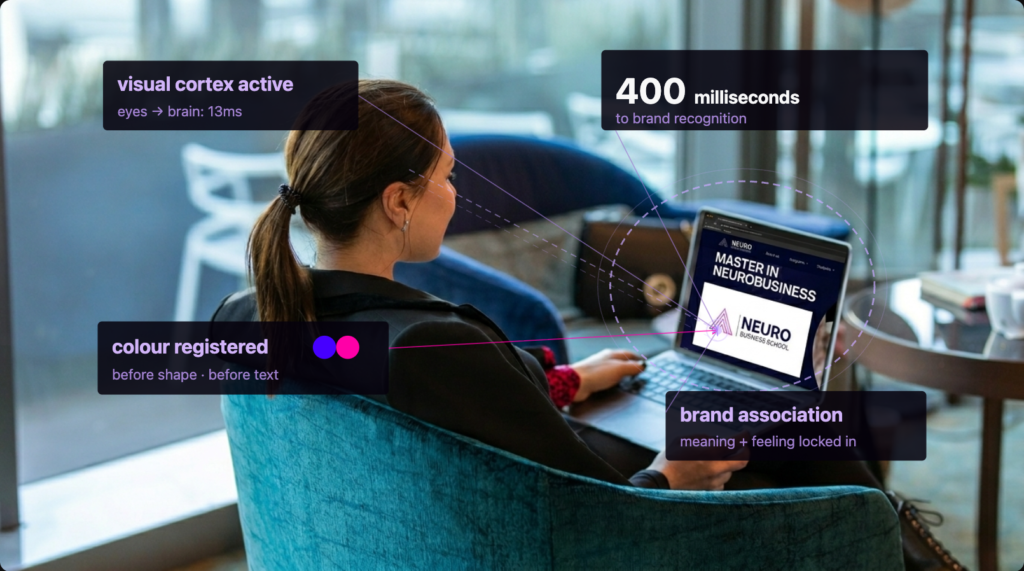
In 400 milliseconds of exposure, the brain has already decided whether a brand is familiar, relevant, or worth paying attention to. Not tentatively. Not as a first draft. The initial read is done, filed, and the next stimulus is already incoming. If your brand didn’t land in that window, there’s no second chance at a first impression — because neurologically speaking, the first impression already happened.
What this article covers:
- • How the visual system processes a brand stimulus in under half a second
- • What encoding specificity means for brand identity — in plain terms
- • Why colour does more work than anything else in that window
- • How brand fluency quietly drives preference without anyone noticing
- • What neuromarketing research actually measures here, and why self-report misses it
What Is the Brain Actually Doing in 400 Milliseconds?
The 400-millisecond figure isn’t an approximation. It comes from research using EEG — electroencephalography — which measures electrical activity in the brain with millisecond precision during controlled visual exposure tasks. When a recognisable brand mark appears in the visual field, measurable neural responses begin within 13 milliseconds of stimulus onset. Object-level recognition — what that thing actually is — completes around 150 to 200 milliseconds. Semantic association — what the brand means, how you feel about it — is measurable by 400 milliseconds.
That cascade runs through several brain structures in sequence. The visual cortex handles the basics first: edges, luminance, colour contrast, motion. The inferior temporal cortex picks up shape and object identity. The prefrontal cortex and amygdala handle valuation and emotional response. These systems overlap and run in parallel — the brain is not a serial processor, doing one thing at a time.
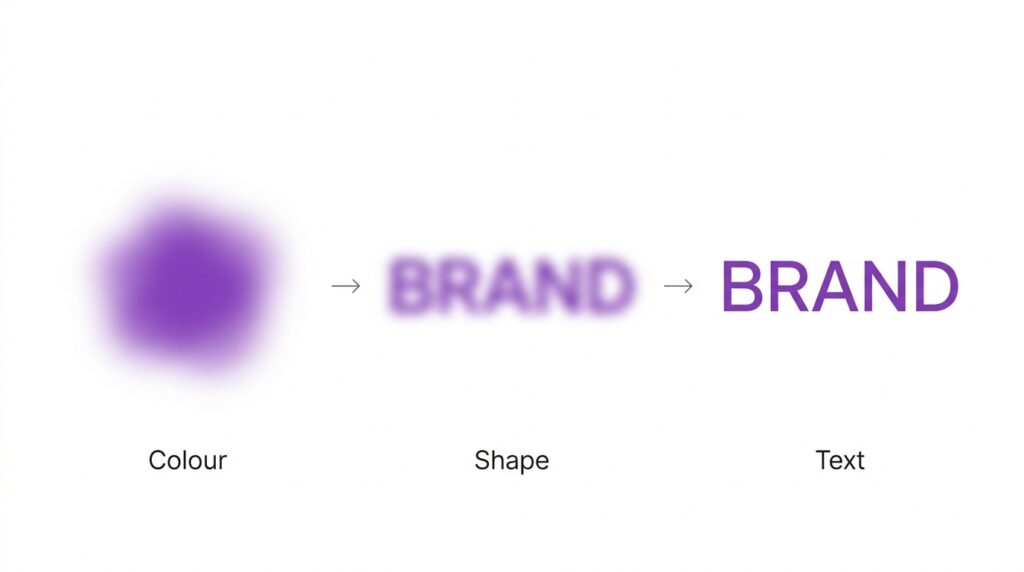
Here’s the part that actually matters for brand strategy: the sequence is fixed. Colour is processed before shape. Shape is resolved before text. Text is always last. So a brand that needs to be read to be understood is asking the brain to do its hardest, slowest task — after the emotional and associative work has already been completed without it.
Almost no brand systems are built explicitly around this processing sequence. Most designers know it intuitively. But understanding the neuroscience changes which decisions you treat as worth fighting for.
What Does ‘Encoding Specificity’ Actually Mean for a Brand?
Memory retrieval is context-dependent. The conditions present when a memory was formed — the surrounding environment, the emotional state, the nearby stimuli — become part of the memory itself. Encoding specificity is the name for this principle: recall works best when the conditions at retrieval match the conditions at encoding.
In plain terms: the brain stores memories in packages. The brand, the context it appeared in, and how it looked all get filed together. Which means a brand that looks consistent across every context builds a memory trace that fires reliably across those same contexts. A brand that varies — different colour treatments, adjusted proportions, alternate lockups for different channels — creates weaker, more fragile traces. It may be recognised in one setting and completely missed in another.
Research in visual memory consistently shows that consistency of exposure predicts recognition better than frequency. Seeing the same brand in the same form ten times outperforms seeing it twenty times across ten different visual treatments. More exposures with less consistency can actually work against you.
This makes brand guideline compliance a neurological question, not an aesthetic one. Every visual inconsistency is noise in the encoding process. The brain is building a model of the brand across every single exposure. Inconsistency makes that model harder to construct and less reliable to retrieve when a real decision is being made.
Why Does Colour Do So Much More Work Than Everything Else?
Colour reaches conscious processing faster than any other visual attribute because it’s handled by a dedicated early pathway in the visual system. Before the brain has finished working out what shape it’s looking at, colour is already encoded. This isn’t a metaphor for “colour is important.” It is literally the order in which those two processes complete.
Research on colour-brand association shows that recognition accuracy drops substantially when brand colours are removed from an otherwise intact logo — more than removing the name, more than altering the shape. Widely cited estimates suggest recognition can fall by up to 80 percent in controlled recognition tasks, though the exact figure varies by study design and by how strongly the colour-brand link was established to begin with. What doesn’t vary: colour carries more brand identity information per millisecond than any other single element.
When a specific colour becomes reliably associated with a specific brand — through consistent, repeated exposure over a long enough period — the visual system starts pre-activating the brand association the moment that colour appears. Before shape is resolved. Before text is read. Tiffany’s blue, Hermès orange, Cadbury’s purple: these aren’t aesthetic choices that happened to work. They are the result of consistent application over decades, long enough for the colour-to-brand connection to become automatic.
Most brands never get there. Not because they chose poorly, but because they changed the colour, diluted it across sub-brands, or allowed inconsistencies that prevented the association from consolidating. The encoding opportunity exists every single time someone encounters the brand. What the brain does with it depends entirely on what you give it to work with.
What Is Brand Fluency and Why Does the Brain Prefer Familiar Things?
Processing fluency is the ease with which the brain handles an incoming stimulus. Familiar things are processed faster and with less effort. That efficiency registers as a faint positive signal — something feels right, recognisable, or trustworthy, without a specific reason you could name. Brand fluency is the accumulated version of this: the processing advantage a brand gains after being encountered many times in consistent form.
Here’s the counterintuitive part. Familiarity generates preference independently of any specific positive association. The brand doesn’t need to have done anything impressive. It just needs to have been seen often enough, in consistent form, for the brain to process it easily. And because the brain uses processing ease as a proxy for safety and legitimacy — an old evolutionary shortcut that never quite updated for the modern world — that ease becomes preference, quietly, without anyone consciously deciding to prefer it.
Worth sitting with for a moment: you can build a brand preference advantage not by being better, but by being more consistently familiar. That sounds too simple. It’s also well-documented.
This also explains something counterintuitive about brand redesigns. An excellent creative overhaul resets the fluency advantage. The brand goes from something the visual system handles effortlessly to something it has to work to parse. That is a real neurological cost — one that takes time and many exposures to rebuild. New visual identities frequently underperform in the short term not because they’re worse, but because the brain hasn’t learned them yet.
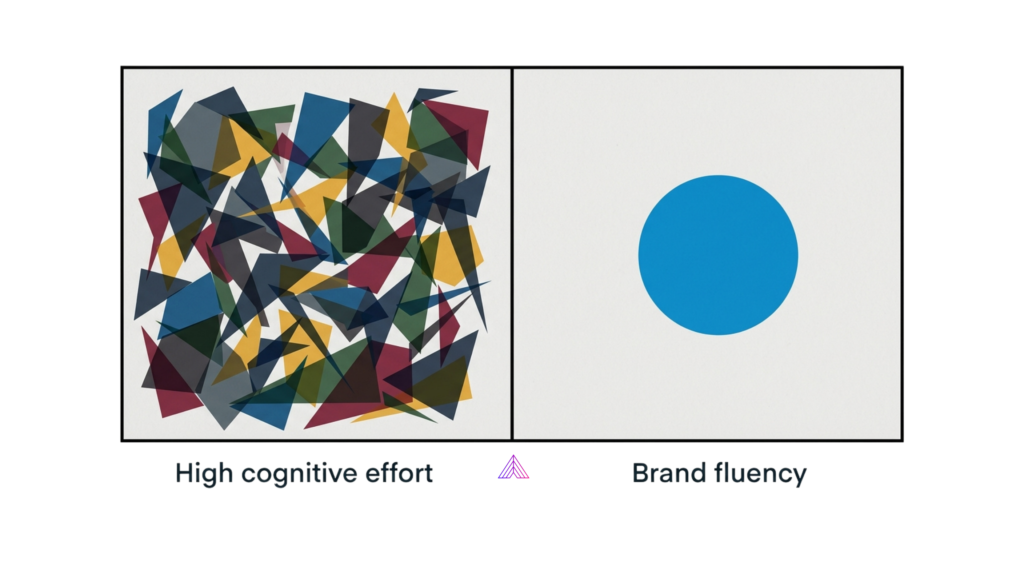
The memory is the brand. Not the logo, not the campaign. The trace left in the brain after repeated, consistent exposure.
How Does Neuromarketing Actually Measure Any of This?
Traditional brand research asks people what they think. Surveys, focus groups, recall tests conducted minutes or hours after exposure. The problem is that the mechanisms described above run below the threshold of conscious awareness. People cannot accurately describe what happened in their brain during 400 milliseconds of visual processing. What they report is a reconstruction — shaped by what they think they should have noticed, what they remember noticing, and what makes a coherent story. It’s not a readout.
Neuromarketing methods skip the reconstruction and go to the source. EEG captures electrical activity with millisecond precision — you can see exactly when a brand stimulus triggers a response, not just whether it did. Eye-tracking records fixation patterns during visual search tasks, revealing which elements capture attention first and how long they hold it. Implicit association testing measures the strength of connections between brand stimuli and evaluative concepts without asking participants to reflect on them consciously.
These tools produce a picture of brand perception built from brain data rather than stated preferences. And that picture frequently contradicts what self-report produces. People say they notice the logo first. The data shows colour registered 80 milliseconds earlier. People say they’d recognise the brand anywhere. The data shows three colour variations have fragmented the memory trace. The gap between what people report and what actually happens in the brain is exactly where brand strategy tends to go wrong.
Neuro Business School’s Master in NeuroMarketing applies these methods to real brand, marketing, and consumer behaviour challenges. The program is available fully online, built for professionals who want to work at this level without stepping away from the career they’re already building.
So What Do You Do With 400 Milliseconds?
The window is fixed. You can’t negotiate with it or slow it down. What you can do is engineer what the brain encounters during it – consistently, across many exposures, in many contexts. The memory is the brand. Not the logo file, the brand values document, or the campaign creative. The trace left in the brain after repeated, consistent exposure is the only thing that exists when a purchasing decision is being made and your brand is not physically present.
The brands that win in visual processing are rarely the ones with the most distinctive creative. They are the ones that made the same choices, consistently, for long enough that those choices became automatic. That is as much an operational discipline as a creative one.
If your brand strategy is built around what your brand says, it’s worth asking what your brand encodes. The brain settles that question 400 milliseconds before you get a word in. Explore what this means for your marketing career at Neuro Business School’s Master in NeuroMarketing.
Sources
- Thorpe, S., Fize, D., & Marlot, C. (1996). Speed of processing in the human visual system. Nature, 381(6582), 520–522. (Object-level recognition timescales — peer-reviewed.)
- Rossion, B., & Jacques, C. (2008). Does physical interstimulus variance account for early electrophysiological face sensitive responses in the human brain? Neuropsychologia, 46(7), 1959–1978. (Visual evoked potentials and EEG timing — peer-reviewed.)
- Hollis, N. (2010). Branding unmasked. Market Research Society Annual Conference. (Colour removal and brand recognition — industry research; exact figures vary by study design and brand familiarity.)
- Tulving, E., & Thomson, D.M. (1973). Encoding specificity and retrieval processes in episodic memory. Psychological Review, 80(5), 352–373. (Encoding specificity — peer-reviewed.)
- Reber, R., Winkielman, P., & Schwarz, N. (1998). Effects of perceptual fluency on affective judgments. Psychological Science, 9(1), 45–48. (Processing fluency and preference — peer-reviewed.)
- Plassmann, H., Ramsoy, T.Z., & Milosavljevic, M. (2012). Branding the brain: A critical review and outlook. Journal of Consumer Psychology, 22(1), 18–36. (Neuromarketing methods in brand research — peer-reviewed review.)