

Studying AI without quitting your job means enrolling in a structured, part-time program built around real business projects – not a pile of free tutorials you’re supposed to power through on your own. That’s very different from what most people picture when they think about “learning AI” right now: a free course, bookmarked, half-finished.
Average completion rates for those free courses sit around 15%, and fall lower the longer the course runs. Meanwhile, job postings requiring AI skills grew 144% year over year in the US, and the wage premium for AI fluency has climbed to 62%. This isn’t a someday problem, it’s already sitting in job descriptions.
Here’s what a real, structured path of the Master in Artificial Intelligence actually looks like.
Why Do Most People Who Start Learning AI Never Finish?
Picture the familiar scene: a free AI course, two modules in, bookmarked for “this weekend” three weekends ago. The number behind that scene is worth sitting with. Katy Jordan’s widely cited analysis of over 200 massive open online courses found average completion rates hovering around 15%, and in many cases far lower – some technical courses finish under 5%.
That’s not a motivation problem spread across millions of individual people. It’s a structural one.
Free courses ask for the one thing a working professional has the least of: unscheduled time, self-generated, with no one checking in. There’s no group moving through the material with you, no deadline attached to a real deliverable, no version of the content connected to your actual job. Almost nobody plans to quit halfway through. It happens gradually: a missed session here, a busier week there, until the course quietly stops being a priority.
Structured programs look completely different: a set group of people move through the material together on a fixed, live schedule, with instructors and deadlines rather than a self-paced video library. Programs built this way report completion rates as high as 70–85%, according to instructional design research from providers including Harvard Business School Online. The difference isn’t the subject matter. It’s the structure around it.
What Does “Studying AI” Actually Mean at a Program Level?

Here’s where a lot of confusion sits. “Study AI” gets used for two very different things: learning to build AI systems (coding, machine learning, model architecture) and learning to direct AI inside a business (strategy, judgment, adoption, decision-making). Most free content online is the first kind, aimed at people who already write code.
A Master in Artificial Intelligence, done properly, sits at the intersection of both without requiring you to become a software engineer. Our version, the Master in Artificial Intelligence & Neuroscience Applied to Business, is more literal than it sounds. The technical foundation is real: data science, machine learning, automation. But the technical side isn’t the whole job, you still have to explain to a skeptical team why an AI investment is worth it, and convince them to actually use what gets built.
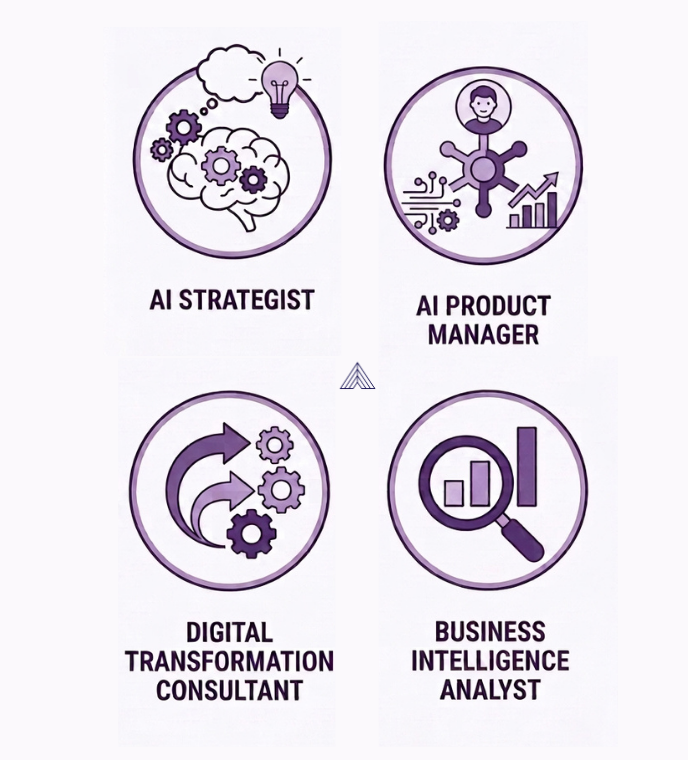
That’s the version of “studying AI” that maps onto where the job titles are actually growing – not just Machine Learning Engineer, but AI Strategist, AI Product Manager, and Digital Transformation Consultant, none of which require writing production code day to day.
What Does the Master in AI Curriculum Actually Cover?
The program breaks down as 80% practical learning: projects, business case studies, and AI lab simulations, and 20% focused on Neuro Research, AI Strategy, and Innovation. In practice, across one academic year, that means eight core modules:
| Module | What it covers |
|---|---|
| AI and Organizations | How AI reshapes culture and business models |
| AI Strategy for Business | Frameworks for implementation, market trends, and ethics |
| Business and Artificial Intelligence | Aligning AI tools with real business goals |
| Data Analysis and Visualization | Turning data into decisions people actually act on |
| Data Science and AI for Decision Making | Predictive analytics and machine learning applied to business scenarios |
| Foundations of Data Science | The analytical groundwork under everything above |
| Open AI and Emerging Technologies | Generative AI, NLP, and the tools reshaping industries right now |
| Neuroscience Applied to Business | Why people trust or resist AI-driven decisions, and what to do about it |
How Does This Actually Fit Around a Full-Time Job?
The program runs one academic year, entirely available fully online (hybrid and on-campus options also exist, for anyone who wants them). There’s personalized mentorship throughout, and a final capstone project aligned with each student’s own professional goals rather than a generic assignment.
That structure is the actual answer to ‘how do I study AI without quitting my job.’ Not a shorter course – a course built to run alongside the one you already have.
What Happens After You Finish?
The honest version of “will this get me a job” is: demand across the field is strong enough that the harder question is which job, not whether one exists.
Career paths cluster around AI Strategist, Data Scientist, Machine Learning Engineer, Business Intelligence Analyst, AI Product Manager, Neuro-Data Analyst, Digital Transformation Consultant, and Innovation Director. Top employers in the field include Google, IBM, Microsoft, Deloitte, and a wide range of neuroscience-driven startups.
None of that happens because someone finally powered through on their own. It happens because the program is built around a real week, with a real project, alongside people going through the same shift at the same time.
Most people don’t fail to learn AI because they’re not capable.
They fail because nobody built the course to fit around a normal work week.
A Final Thought
The AI skills gap isn’t really a knowledge gap. Plenty of free material exists, more than anyone could reasonably get through. What’s actually missing is a structure that survives contact with a real job, a real calendar, and a normal amount of exhaustion by the end of the week. That’s the gap a proper program is built to close: not by teaching something different, but by teaching it in a way that actually gets finished.
The Master in Artificial Intelligence runs one academic year, entirely online, around a job you’re not planning to leave.
Sources:
1. Jordan, K. (2015). Massive open online course completion rates revisited: Assessment, length and attrition
2. Harvard Business School Online / Acumen, instructional design data on cohort-based course completion rates, as reported by EdSurge (2019).
3. PwC (2025). Global AI Jobs Barometer: job postings requiring AI skills grew 144% year-over-year; AI-skills wage premium reached 62% in 2026.
4. edX/Lightcast data (Aug 2025): job postings requiring AI skills roughly tripled (73% then 109% growth) between 2023 and 2025.
5. Neuro Business School, Master in Artificial Intelligence program data – curriculum structure, career outcomes, and employability figures, as published on eunbs.com.