

By early afternoon, your brain is measurably worse at making good decisions than it was at 8am. Not because you’re tired, not because the problems got harder. Because your brain’s capacity for deliberate, careful thinking is a limited resource — and you’ve been spending it since you woke up.
This is not a productivity myth. The neuroscience is clear: decision fatigue is a real, measurable phenomenon that degrades judgment, increases impulsivity, and makes you more likely to avoid decisions altogether rather than make them badly. The only variable is when it hits you — and for most people in demanding professional roles, it hits earlier than they’d like to believe.
What this article covers:
- •🧠 Why the brain’s decision-making capacity depletes across the day
- •🔬 The neuroscience behind ego depletion and glucose regulation
- •🌅 What the research says about morning cognitive windows
- •📉 How decision debt accumulates — and compounds
- •🎯 Practical ways to protect your best thinking for the decisions that matter most
What is actually happening in your brain when you make a decision?
Every decision you make — from whether to take the lift or the stairs to whether to sign off on a strategy — runs through the prefrontal cortex, the region of the brain responsible for complex reasoning, impulse control, and evaluating trade-offs. It is the most metabolically expensive part of your brain to run.
The prefrontal cortex doesn’t fatigue the way a muscle does, but it does require a steady supply of glucose to sustain high-quality processing. As the day progresses and decisions accumulate, the cortex becomes less efficient — not because neurons are damaged, but because maintaining focused deliberative function is genuinely resource-intensive.
What makes this particularly tricky: the subjective sense of effort doesn’t keep pace with the actual decline in quality. You don’t feel dramatically worse at 3pm than you did at 9am. You just make slightly worse choices — more impulsive, more influenced by default options, more likely to defer rather than decide — without noticing.
Almost no one accounts for this. They schedule their hardest thinking for whatever time happens to be free.
What does ego depletion actually mean?
The concept of ego depletion was introduced by social psychologist Roy Baumeister in the late 1990s, and while its original experimental findings have been through several rounds of replication debate, the core neuroscientific mechanism — that effortful self-regulation draws on a shared, finite resource — has held up in broader cognitive research.
The theory is this: every act of self-control, deliberate decision, or cognitive trade-off draws on the same underlying pool of executive function capacity. Make enough of them in sequence, and the quality of subsequent decisions declines. The depletion isn’t permanent — rest, food, and breaks restore function — but within a working day, the cumulative effect is real.
A well-known study by Shai Danziger and colleagues (2011) tracked the decisions of Israeli parole judges across a single day. Prisoners who appeared earlier in the day received favourable rulings roughly 65% of the time. By the end of each session, that figure dropped close to zero — before resetting after a break. The variable wasn’t the cases; it was the state of the judge’s brain.
The best decision you’ll make today is almost certainly one you make early. The worst is probably one you make when you thought you had nothing left to decide.
How do glucose and cortisol factor in?
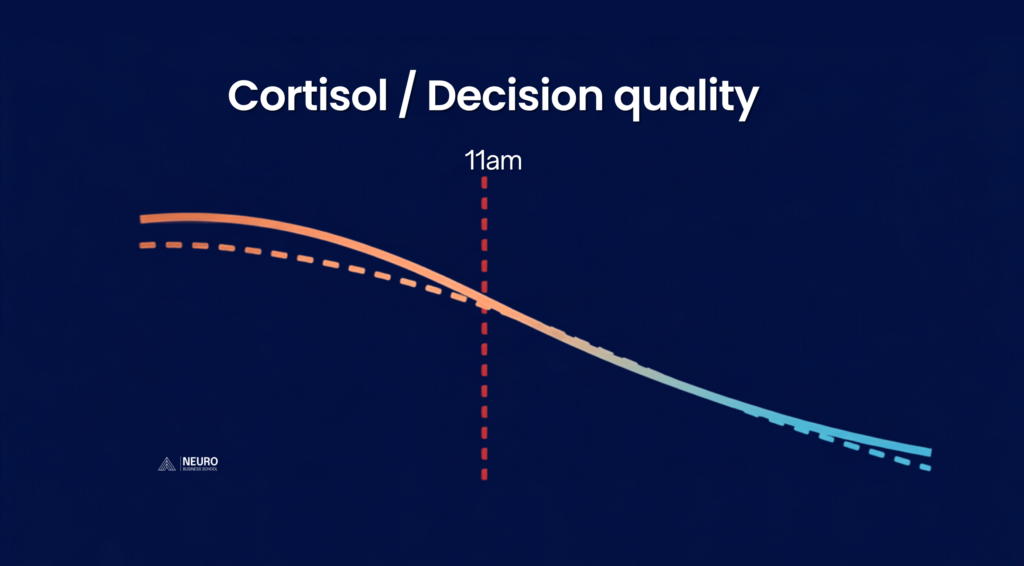
Two biological mechanisms are particularly relevant to decision quality across a workday: glucose and cortisol.
Glucose is the brain’s primary fuel. Executive functions — including the kind of reasoning required for consequential decisions — are disproportionately sensitive to glucose availability. Several studies have shown that acts of self-regulation deplete blood glucose levels, and that replenishment (via a small sugary drink in experimental conditions) temporarily restored performance. This is a blunt tool in real life, but the underlying mechanism explains why complex decision-making before lunch feels different from the same task mid-afternoon.
Cortisol — the body’s primary stress hormone — follows a natural daily rhythm. It peaks sharply in the first 30–60 minutes after waking (the cortisol awakening response), which is associated with heightened alertness, sharper focus, and faster working memory. For most people, this window begins declining by mid-morning. By early afternoon, cortisol has dropped significantly, and with it, the biological substrate for high-quality deliberate reasoning.
The practical implication is that your biology is optimised for precise, effortful thinking in the hours after waking. This isn’t a productivity hack. It’s physiology.
What is decision debt and why does it compound?

Every trivial decision you make in the morning — what to have for breakfast, whether to respond to that message now, which meeting to reschedule — costs something. The cognitive cost of any single low-stakes decision is negligible. The cumulative cost of dozens of them is not.
This is what we can call decision debt: the accumulated drag on executive function created by decisions that didn’t need to be made when they were made. The analogy to financial debt is apt: the principal is small, but the interest compounds across the day.
Leaders and senior professionals are particularly exposed to this because their days are structured around constant input and response. Every message, meeting, or request is a micro-decision about prioritisation — even if it doesn’t feel like one. By the time the genuinely important decision arrives, the budget has been partly spent.
The research on this is consistent with what experienced executives often describe intuitively: their best strategic thinking happens early in the day, in protected time, before the accumulation begins. The ones who protect that window deliberately tend to make better use of it.
How can you protect your best thinking?
The goal is not to make fewer decisions in total — that’s not realistic in most professional roles. The goal is to schedule the decisions that require your highest cognitive functioning during the period when that functioning is at its peak.
A few approaches that are supported by the underlying neuroscience:
- •🧠⏰ Front-load your consequential decisions. Schedule high-stakes choices — hiring, strategy, contracts — before 11am. Not because it’s a rule, but because that’s when your prefrontal cortex is most likely to give you its best work.
- •⚙️📉 Reduce decision volume, not decision quality. Automate or batch low-stakes decisions — standing meetings, recurring processes, default preferences. The point isn’t to avoid deciding; it’s to stop spending deliberate cognitive resources on things that don’t need them.
- •☕🚶♀️ Build in breaks before important decisions. The Danziger data, contested as it is, illustrates something real: breaks restore function. A 10-minute walk or a proper lunch before a critical decision is not wasted time.
- •🧭⚠️ Notice when you’re deferring. The most reliable sign of advanced decision fatigue isn’t a bad decision — it’s the impulse to avoid deciding altogether. If you’re repeatedly postponing things that should be resolvable, the problem may be cognitive resources, not the decision itself.
The bigger picture
Understanding the neuroscience of decision fatigue is not about becoming more productive in a self-optimisation sense. It’s about recognising that the quality of your decisions is not constant — and that pretending otherwise has real consequences.
Senior professionals and executives make decisions that affect teams, clients, and organisations. The assumption that any time is equally good for those decisions is not supported by the science. Deliberate scheduling of high-stakes thinking is a form of cognitive hygiene, not a luxury.
The Executive Neuro MBA at Neuro Business School explores the neuroscience of leadership — including how cognitive processes drive the decisions that define careers. The program is available fully online.
SOURCES
- Baumeister, R. F., Bratslavsky, E., Muraven, M., & Tice, D. M. (1998). Ego depletion: Is the active self a limited resource? Journal of Personality and Social Psychology, 74(5), 1252–1265.
- Danziger, S., Levav, J., & Avnaim-Pesso, L. (2011). Extraneous factors in judicial decisions. Proceedings of the National Academy of Sciences, 108(17), 6889–6892.
- Gailliot, M. T., & Baumeister, R. F. (2007). The physiology of willpower: Linking blood glucose to self-control. Personality and Social Psychology Review, 11(4), 303–327.
- Hagger, M. S., et al. (2016). A multilab preregistered replication of the ego-depletion effect. Perspectives on Psychological Science, 11(4), 546–573.
- Crum, A. J., & Langer, E. J. (2007). Mind-set matters: Exercise and the placebo effect. Psychological Science, 18(2), 165–171.
- Wüst, S., et al. (2000). The cortisol awakening response — Normal values and confounds. Noise & Health, 2(7), 79–88.
- Kahneman, D. (2011). Thinking, Fast and Slow. Farrar, Straus and Giroux.