
You have never bought something you didn’t need. The product was genuinely limited. The window was closing. The deal was, objectively, good.
This is what every urgency mechanic in modern commerce relies on. Not manipulation — a feature of how the human brain evaluates value. When supply appears constrained or time is running short, the brain doesn’t create urgency — it reveals it. These triggers are persistent, universal, and difficult to override even when you can see them coming. That last part is the one worth understanding.

What this article covers:
- Why scarcity makes things feel more valuable even when nothing has changed
- How loss aversion and FOMO work at the neurological level
- Why the dopamine hit peaks before the product arrives — and what that means for purchase regret
Why Does Scarcity Make Things Feel More Valuable?
The scarcity heuristic is one of the most documented shortcuts in decision science. When something appears rare, the brain treats that rarity as a proxy for value — whether or not the relationship holds in this specific case.
Robert Cialdini’s research on social influence formalised this, but the mechanism is far older. In environments where resources genuinely were scarce, acting decisively on scarcity signals was adaptive. The reflex stuck. Now it operates in a world engineered to trigger it on demand.
A product labelled ‘only 3 left’ is processed differently than the identical product with no inventory signal, even at the same price. The brain is not comparing items rationally. It is responding to a signal that historically predicted value.
Almost nobody acts on this knowledge in the moment. Which is exactly what makes it commercially durable.
Before acting on a limited-availability signal: is the scarcity real, or manufactured? And would it matter to you either way?
Does Losing Something Really Hurt More Than Gaining It Feels Good?
Yes — roughly twice as much. This is loss aversion, formalised by Tversky and Kahneman, and one of the most replicated findings in behavioural economics. The psychological impact of losing something is approximately double the equivalent gain. A stable feature of human decision-making, not a cultural quirk.
FOMO is loss aversion applied to experiences, social access, and opportunity. When a closing offer or a limited enrollment window triggers anxiety, the brain is already registering a potential loss before the gain has been evaluated. The asymmetry does the work before conscious reasoning starts.
This is why ‘don’t miss out’ outperforms ‘take this opportunity’. Grammatically similar, neurologically different. One activates loss aversion directly. The other asks the brain to calculate what it stands to gain — which gives doubt more room to enter.
The urgency you feel around a closing offer is real, neurologically speaking. Whether it corresponds to a real reason to act is a separate question.
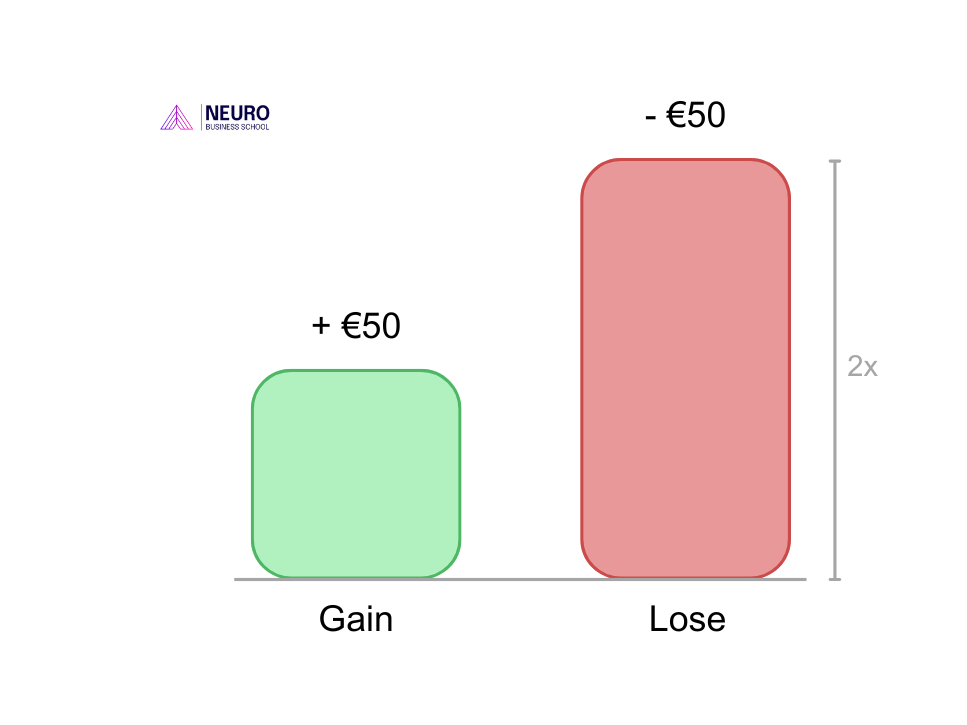
The pain of losing is roughly twice the pleasure of gaining. FOMO is not anxiety — it is loss aversion in a different setting.
Why Does ‘Today Only’ Feel Different From the Same Deal Tomorrow?
Because of present bias: the brain’s tendency to overweight immediate rewards relative to future ones, even when the future reward is objectively larger. A discount available today registers more strongly than the same discount announced a week in advance.
The neural basis involves competing systems. The limbic system processes immediate rewards with high emotional salience. The prefrontal cortex weighs longer-term consequences. Limited-time offers ask the limbic system to respond before the prefrontal cortex finishes its analysis.
Countdown timers don’t change the offer — they change the temporal framing. Research on time pressure and decision-making consistently shows compressed timelines increase purchase likelihood and reduce deliberation, independent of offer quality.
Knowing that time pressure affects your decisions does not make you immune to time pressure. This is obvious in retrospect. It keeps working anyway.
Why Do You Feel Satisfied the Moment You Click ‘Buy’ — Before Anything Arrives?
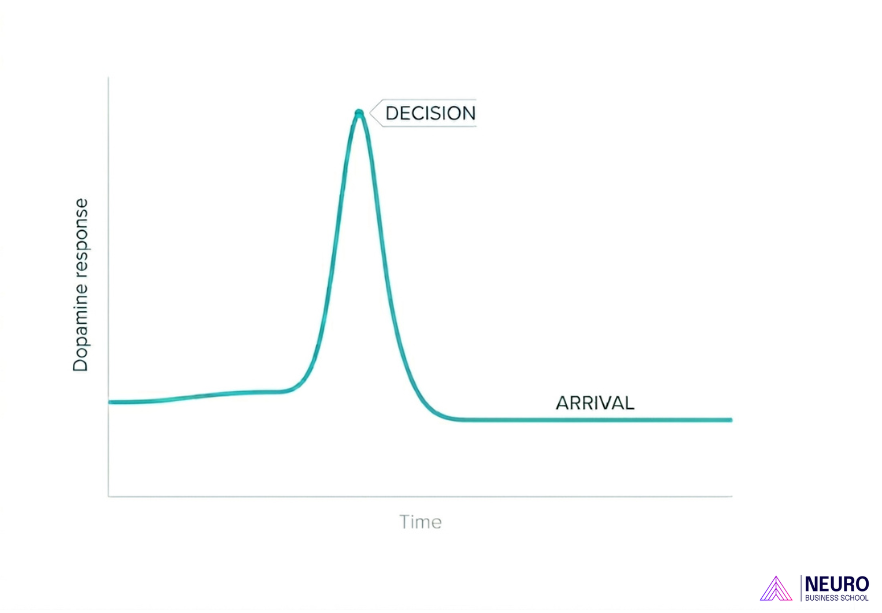
The role of dopamine in impulse purchasing is more nuanced than popular accounts suggest. Dopamine is not primarily a reward signal. It is an anticipation signal. The spike occurs during the build-up to acquisition, not after.
Wolfram Schultz’s research on primate reward systems showed that dopamine neurons respond most strongly to cues that predict reward, not to the reward itself. Once reward is delivered, the signal either holds steady (if it matched expectations) or drops (if it disappointed).
An impulse buy is neurochemically satisfying the moment you decide: clicking ‘add to cart’, completing checkout, seeing the confirmation screen. The product arriving days later triggers a substantially weaker response. This is why purchase regret tracks so closely with impulsive decisions. The peak reward was the anticipation. The product cannot deliver what the anticipation promised.
The click is the reward. Everything after is just delivery.
So What Can You Actually Do With This?
Understanding these mechanisms is not an argument for cynicism about marketing. It is an argument for precision. Knowing when you are being triggered, and whether the trigger corresponds to something you genuinely want, is worth more than any individual purchase decision.
For practitioners — marketers, product designers, communications professionals — behavioural science offers a model of how decisions actually get made. When you understand loss aversion, present bias, and the dopamine anticipation loop, you can design campaigns and products that serve customers. Or you can exploit them. The knowledge is identical. The application is a choice.
Businesses that use scarcity and urgency honestly tend to win over longer timeframes. Manufactured scarcity produces one-time conversions. Real scarcity produces loyalty. The neurological response is similar. The customer outcome is not.
There is a well-documented gap between knowing about a cognitive bias and changing behaviour because of it. Awareness helps — but only if you pause long enough to use it.
The brain’s response to scarcity, loss, and time pressure is not a design flaw. These systems evolved for environments where they were reliably useful. What has changed is the environment, not the brain. The urgency you feel in front of a closing offer is neurologically real. Whether it corresponds to a real reason to act is the only question worth pausing for.
These principles sit at the core of what Neuro Business School’s Master in NeuroMarketing applies to strategy, consumer behaviour, and decision design. The program is available fully online, built for professionals who want to apply this thinking without stepping away from the work they are already doing.
Sources
- Cialdini, R.B. (1984). Influence: The Psychology of Persuasion. Harper Collins. (Scarcity principle; widely cited applied research, not a single controlled experiment.)
- Tversky, A., & Kahneman, D. (1992). Advances in prospect theory: Cumulative representation of uncertainty. Journal of Risk and Uncertainty, 5(4), 297–323. (Loss aversion — peer-reviewed. The 2:1 asymmetry is a widely cited approximation, not a single precise measurement.)
- Kahneman, D. (2011). Thinking, Fast and Slow. Farrar, Straus and Giroux. (Present bias, competing systems, decision-making under time pressure.)
- Schultz, W., Dayan, P., & Montague, P.R. (1997). A neural substrate of prediction and reward. Science, 275(5306), 1593–1599. (Dopamine as anticipation signal — peer-reviewed neuroscience.)
- O’Donoghue, T., & Rabin, M. (1999). Doing it now or later. American Economic Review, 89(1), 103–124. (Present bias — peer-reviewed economics.)