

Photo by Vitaly Gariev on Unsplash
Picture someone who has given the same pitch fifty times. They know it cold. They could do it half-asleep.
Then the one time it actually matters most, in front of the board, in front of the client who could make or break the quarter, they stumble through it like they have never seen the material before.
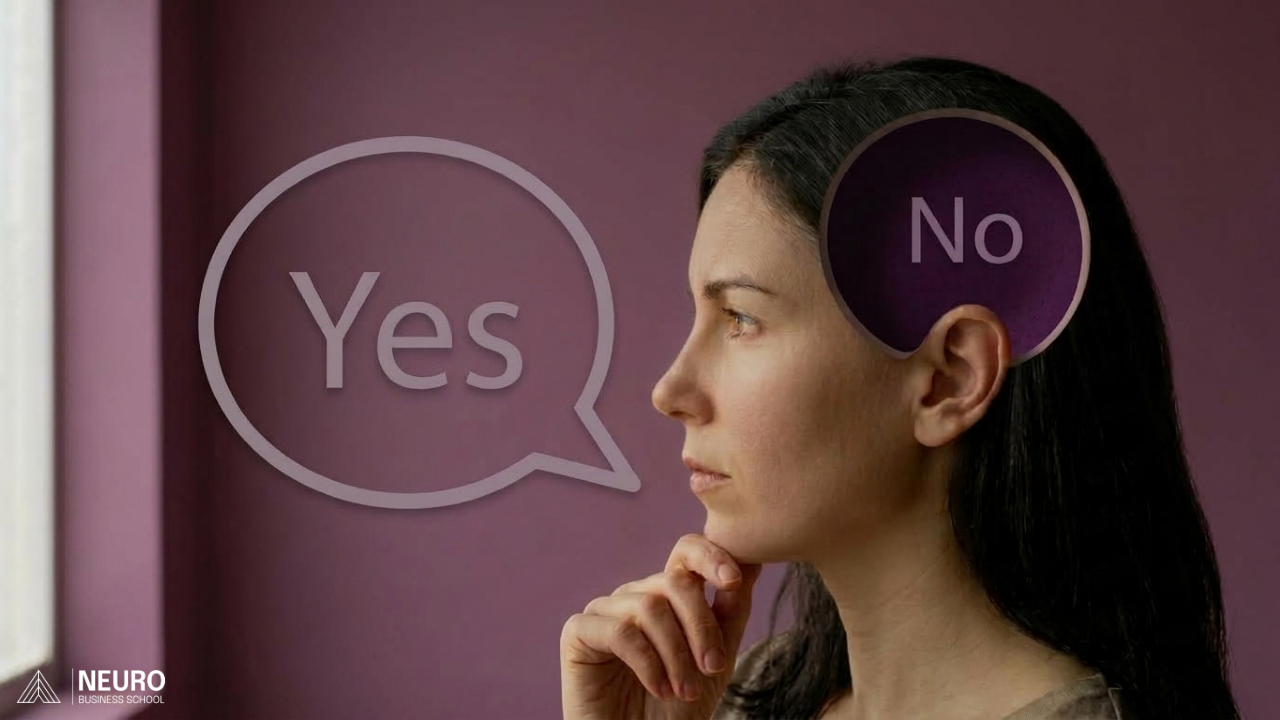
That is not a confidence problem. Under real pressure, the brain does not simply get more emotional or shut down. It does something more specific, and more useful to understand: it switches which system is running the show.
This article breaks down what that switch actually is, why it hits skilled, experienced professionals hardest, and what actually helps in the moment it counts.
What this article covers:
🧠 Why being genuinely good at something makes you more exposed to fumbling it under pressure
🎯 What researchers call “explicit monitoring,” and why it breaks automatic skill
📊 Why beginners can actually be unaffected by the very thing that derails experts
🛠️ What actually reduces this in high-stakes moments, based on the research
💼 What this means for how leaders prepare for the moments that matter most
Why Does Being Good at Something Make You More Likely to Fumble It Under Pressure?
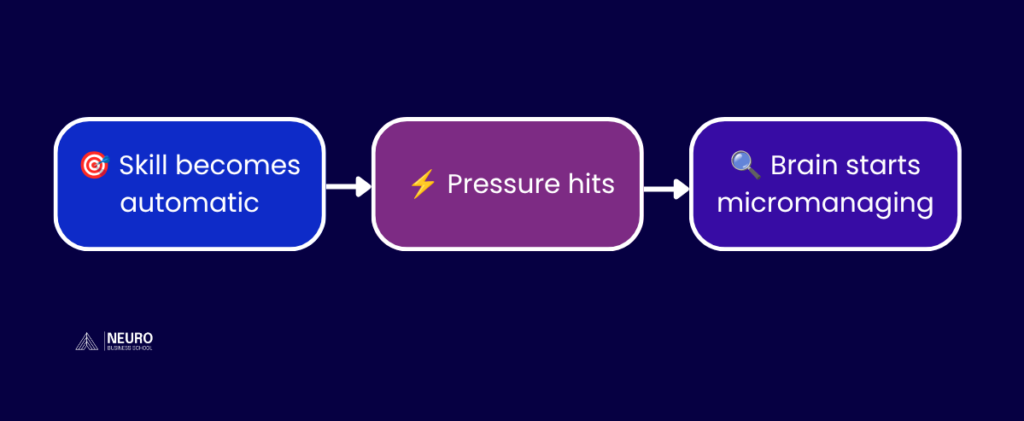
When a skill is genuinely mastered, the brain runs it automatically. You do not consciously think through each step of a pitch you have given fifty times. It just flows, the same way an experienced driver does not consciously think through every hand movement on a familiar road.
Under real pressure, something counterproductive happens. The brain starts paying too much attention. Researchers Sian Beilock and Thomas Carr call this explicit monitoring: consciously watching and controlling each step of something that was never meant to be run consciously. In one of their best known studies, skilled golfers putted noticeably worse when instructed to pay close attention to their own stroke mechanics. Novice golfers were not hurt the same way, and sometimes even improved.
The mechanism is not laziness, nerves, or lack of preparation. It is the brain’s automatic-skill system getting interrupted by the brain’s conscious-monitoring system, at exactly the wrong moment.
Why Does This Hit Skilled People Hardest?
Novices are still building a skill step by step. Conscious attention to the mechanics is part of how they learn, so pressure that increases self-monitoring does not disrupt much, because they were already monitoring themselves closely.
Experts have shifted control of the skill to automatic circuits precisely because that frees up conscious attention for higher-level judgment calls. Forcing that attention back onto the mechanics does not sharpen the performance. It interrupts a system that was built to run without it.
The people most likely to fumble under pressure
are usually the ones who know exactly what they are doing.
That is why the most prepared person in the room, not the least prepared one, is sometimes the one who stumbles. The mechanism runs on expertise, not on how ready someone actually is.
What Actually Helps in High-Stakes Moments?
A few findings from the research point toward practical fixes, none of which involve trying harder to “stay calm.”
🎯 Focus on the outcome, not the mechanics. Research on attentional focus, led by sport scientist Gabriele Wulf, has repeatedly found that directing attention to the intended result, not the technique behind it, protects automatic performance under pressure.
🔁 Rehearse under simulated pressure. Practicing in front of a small, honest audience before the real one builds a skill that holds up to being watched, not just a skill that works alone in a quiet room.
📋 Use a routine, not a hope. A short, well-rehearsed pre-performance routine gives the brain something structured to do in the moments before a high-stakes task, which leaves less room for conscious monitoring to take over.
🗣️ Name the pressure instead of suppressing it. Briefly acknowledging that a moment is high-stakes, rather than pretending it is routine, tends to reduce the spiral of self-monitoring more than forcing false calm does.
What Does This Mean for How Leaders Prepare?

Image by wavebreakmedia_micro on Freepik
Executives face this exact mechanism constantly: board updates, investor pitches, live negotiations, moments where the room is watching closely and the stakes are real. Framed as a character flaw, this pattern feels impossible to fix. Framed as a specific, well-documented mechanism, it becomes something that can be trained around.
The Executive Neuro MBA at NEURO Business School covers decision-making and performance under pressure as part of its applied leadership curriculum, grounded in exactly this kind of research. The program is available fully online, built for professionals who do not have the option to step away from their careers to build this skill.
Sources
1. Beilock, S. L., & Carr, T. H. (2001). On the fragility of skilled performance: What governs choking under pressure? Journal of Experimental Psychology: General, 130(4), 701–725.
2. Baumeister, R. F. (1984). Choking under pressure: Self-consciousness and paradoxical effects of incentives on skillful performance. Journal of Personality and Social Psychology, 46(3), 610–620.
3. Beilock, S. L. (2010). Choke: What the Secrets of the Brain Reveal About Getting It Right When You Have To. Free Press.
4. Wulf, G. (2013). Attentional focus and motor learning: A review of 15 years. International Review of Sport and Exercise Psychology, 6(1), 77–104.