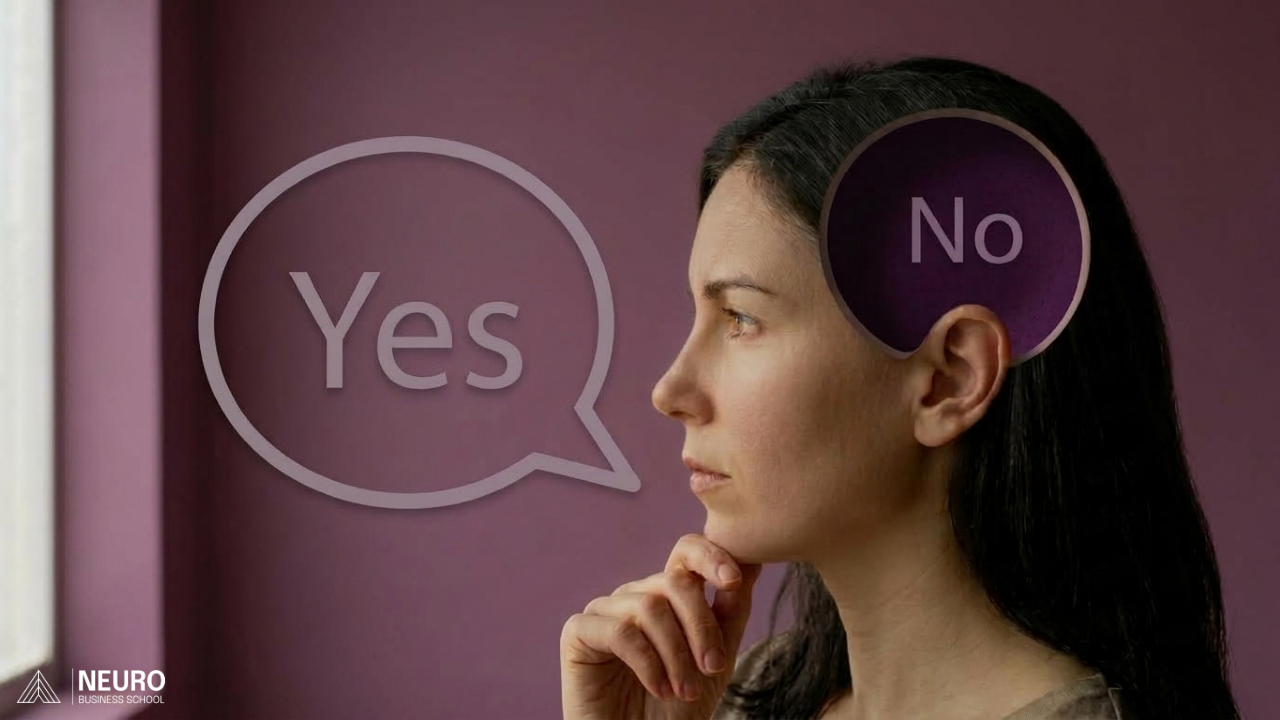


A salesperson skipped the cheap plan and recommended something pricier instead — no hard sell, no comparison chart, just one confident recommendation. The client said yes in under a minute.
That’s not a lucky guess. It’s behavioral science, and you’re probably already using pieces of it without knowing the name for it.
What this article covers:
🧠 Why losing feels worse than winning feels good, and what that does to a sale
🛍️ Why one option beats three, almost every time
🎯 The bias nobody opts out of, not even the experts
💰 Where you’ve probably already seen this in your own work
📌 How companies build this in on purpose
Losses hurt more than gains feel good

Photo by www.kaboompics.com on Pexels
Nobel-winning research by Daniel Kahneman and Amos Tversky found something simple and a little brutal: losing $100 hurts about twice as much as gaining $100 feels good.
That’s loss aversion. It’s likely why the client didn’t pick the cheapest option. Cheap felt risky. Paying a bit more to avoid that risk felt safer, even though nobody used the word “risk” out loud.
👉 Frame what a customer stands to lose, not just what they gain by paying more. Same offer, different reaction.
One option beats three

Photo by Georg Eiermann on Unsplash
A well-known experiment set up a jam table in a grocery store. Some days it had 24 flavors, other days just 6. More flavors pulled more people in to look. But only 3% of them bought anything. At the smaller table, 30% did — ten times the conversion, from fewer choices.
Too many options doesn’t feel like freedom. It feels like more ways to make the wrong call, so people often just walk away instead.
👉 That’s why the strongest offers don’t hand over five plans and a spreadsheet. They hand over one, with a clear reason attached.
The bias nobody opts out of
Ask for €50,000 in a negotiation, even if €30,000 is the real number, and the entire conversation happens near €50,000. That’s anchoring: the first number mentioned becomes the reference point everyone measures against, fair or not.
Expertise doesn’t protect against it. Executives, doctors, and PhD economists fall for it about as often as everyone else, when tested.
👉 The fix isn’t willpower. It’s structure: set the first number yourself, before someone else sets it for you.
Where you’ve probably already seen this

None of this is theoretical. A few places it shows up constantly:
•🏷️ A pricing page with three tiers, where the middle one is quietly the “best value” – that’s the decoy effect: add an option nobody’s really meant to pick, and it makes another option look better by comparison.
•🔁 A subscription that auto-renews unless you cancel – that’s the default effect. Most people stick with whatever requires no action.
•🚨 “Only 2 left in stock” – scarcity paired with loss aversion, reminding you what you’d miss out on rather than what you’d gain.
You’ve been on the receiving end of these more times than you can count. The difference between noticing them and using them deliberately is most of what this field actually is.
Make the decision once, not every time
One employer savings program asked employees a single question: when your next raise comes, should part of it go straight into savings? People said yes easily, because it was about money they didn’t have yet, so it didn’t feel like giving anything up.
Later, when the raise actually arrived, the extra saving just happened automatically. There was no moment where anyone had to choose saving over spending with real cash already in hand, the hardest version of that decision. Three years in, average savings rates had climbed from 3.5% to 13.6%.
👉 Nobody got more disciplined. They just never had to make the hard version of that choice.
The takeaway
None of this makes people predictable the way a spreadsheet is predictable. It makes them readable, which is far more useful.
👉 The Master in NeuroMarketing at Neuro Business School teaches exactly this: how to read decisions like this one on purpose, not by accident. Available fully online, whenever you’re ready to start.
Sources
1. Kahneman, D., & Tversky, A. (1979). Prospect Theory: An Analysis of Decision under Risk. Econometrica, 47(2), 263-291.
2. Iyengar, S. S., & Lepper, M. R. (2000). When Choice is Demotivating: Can One Desire Too Much of a Good Thing? Journal of Personality and Social Psychology, 79(6), 995-1006.
3. Thaler, R. H., & Benartzi, S. (2004). Save More Tomorrow: Using Behavioral Economics to Increase Employee Saving. Journal of Political Economy, 112(S1), S164-S187.
4. Huber, J., Payne, J. W., & Puto, C. (1982). Adding Asymmetrically Dominated Alternatives: Violations of Regularity and the Similarity Hypothesis. Journal of Consumer Research, 9(1), 90-98.